Geometry 2: Discrete differential geometry
Discrete differential geometry translates the concepts of smooth differential geometry into a discrete setting, replacing smooth surfaces with discrete ...
Geometry 2: Discrete differential geometry
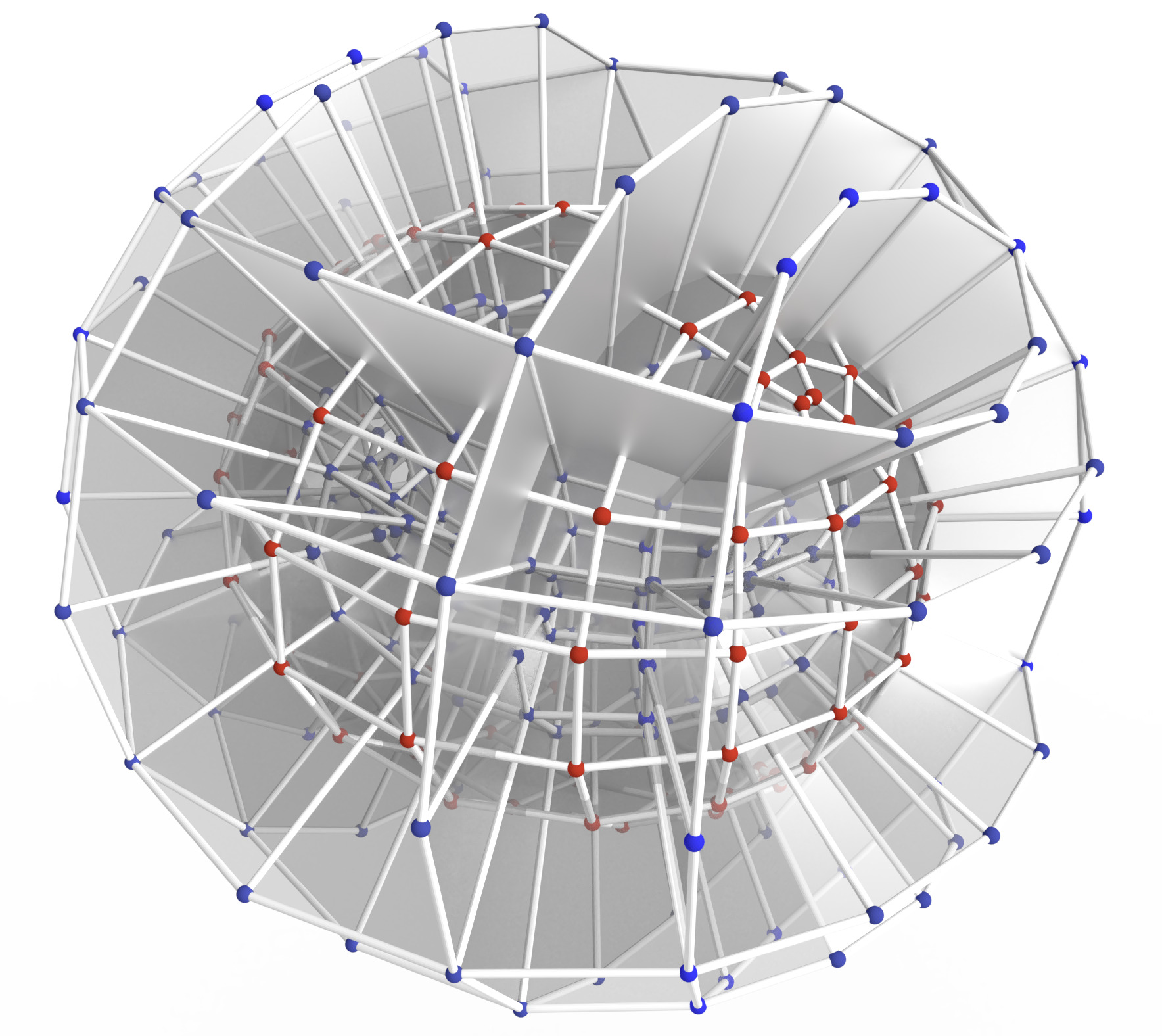
Discrete differential geometry translates the concepts of smooth differential geometry into a discrete setting, replacing smooth surfaces with discrete meshes that retain their fundamental properties. We will study various discretizations of parametrized surfaces and coordinate systems, guided by two organizing principles. First is the transformation group principle, requiring discretizations to share the invariance of their smooth counterparts under the transformation groups of geometries like Möbius, Laguerre, and Lie geometry. Second is the consistency principle from discrete integrable systems, requiring a discretization's extendability to higher-dimensional lattices. These principles together lead to interesting discretizations of special surface classes such as isothermic, minimal, and constant mean curvature (CMC) surfaces. Applications of this theory can be found in areas such as computer graphics and architectural design.