
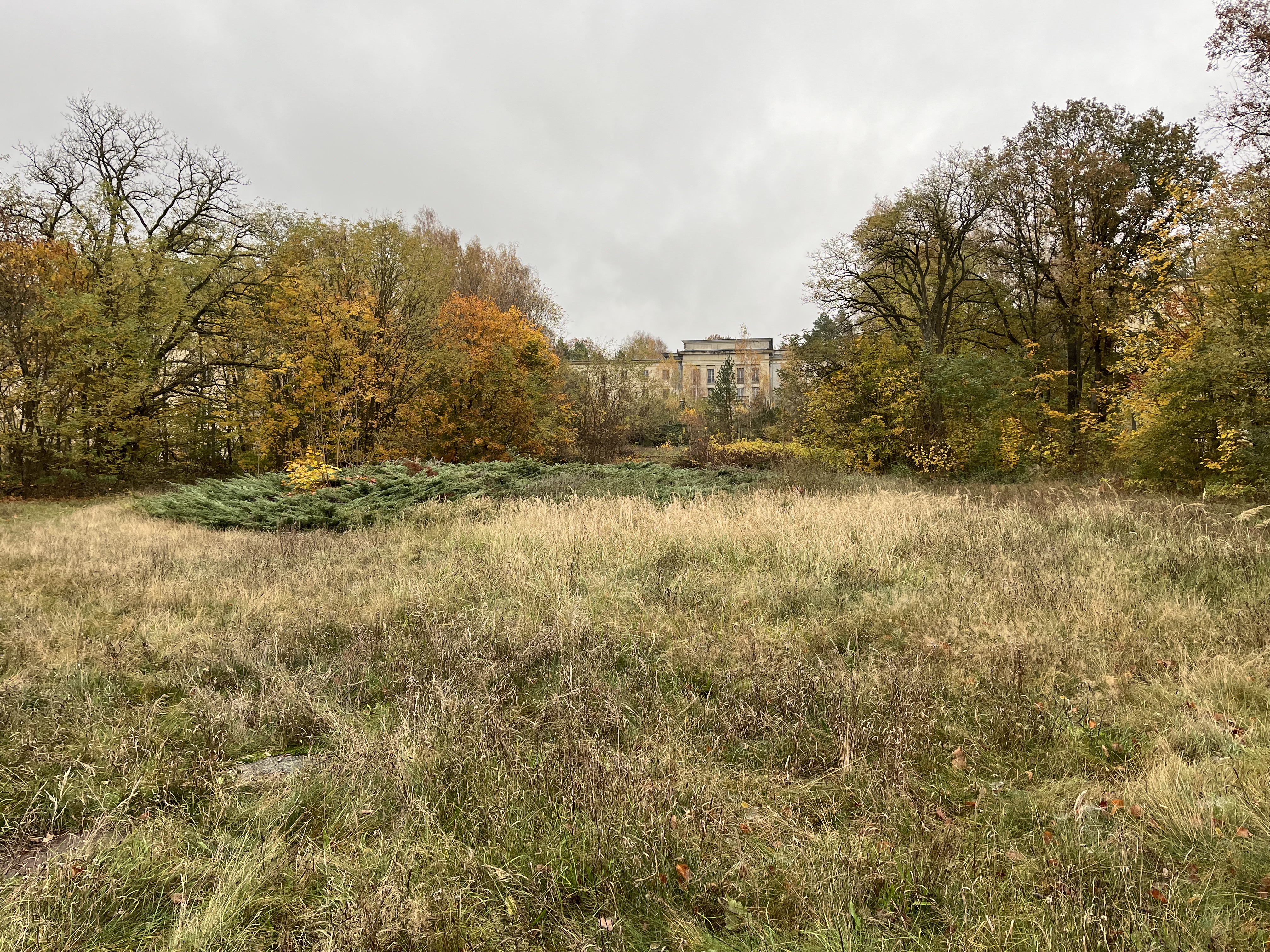
The site of Bogensee — its buildings, lake, and surrounding forest— is marked by a complex history and domination over the territory: first serving as hunting ground, then hosting the Göbels villa, and finally finding an educational vocation with the development of a campus for international students in the GDR time. Today, the future of the abandoned site is the focus for multiple discussions across stakeholders and the public. cue suggest approaching the inherent dilemmas of Bogensee’s futures through two intertwined research and design trajectories:
A. Dissonant heritage and nature resilience: How do we engage with a contested site, marked by multiple traumatic histories? What memories and agencies do the landscape, its buildings, plants and microbes hold? How do we make justice to and hold space for the complexity of the site? Centered around the figure of the ruin as a means to articulate both past and possible futures, we will engage with archival and on-site methodologies across critical landscape theory and political ecology, in order to investigate the confluence of political heritage and nature resilience.
B. Urban development vs. compensation landscape: How can we foresee possible future scenarios for Bogensee in the face of the conflicting challenges of both ongoing housing and climate crises? Bogensee’s brachen and vacant buildings are regarded as a land resource for urban development in Berlin-Brandenburg. We will explore two diverging territorial strategies: The first strategy expands the urban footprint through the redevelopment of abandoned infrastructure and brownfields in the outskirts of the city as an opportunity to preserve the remining open soils in the city center. The second strategy accentuates the urban-rural divide through the rewilding of vacant land in the periphery, as a compensation measure for the open spaces consumed by the inward densification of the metropolitan core. Following upon the urban design studio “Tempelhof Ecologies — How not to build” held in 2025, “Bogensee Ecologies” encourages students to explore the question of “how to rewild”, as a crucial skill to be acquired by architects and spatial practitioners in the face of the multiple challenges and new endeavors related to climate change and other environmental crises. Based on a trans-scalar approach, the studio aims to articulate transdisciplinary mappings and the exploration of alternative futures for both the site of Bogensee and the larger Berlin-Brandenburg territory. While the studio begins with a close confrontation to the site through a transdisciplinary survey and residence workshop, we will engage later during the semester with scaling up and extrapolating what can be learned from Bogensee and other comparable sites at the territorial level. The two proposed trajectories critically address the dichotomies of abandonment vs. reuse, and densification vs. compensation, through which the historical and territorial dimensions of the site emerge in interrelation to both political and scientific ecology. Asking “how to rewild?” therefore invites students to engage in the contemporary debate on urban development and densification strategies for Berlin-Brandenburg. As a process of decision-making, what to “erase” and what to “protect” questions the values usually attributed to the built and non-built environments. We advocate for a design and research approach exploring potential cultural and environmental resilience pathways to human impacts on the territory, space and the living world.
- Trainer/in: Aniella Sophie Goldinger
- Trainer/in: Alexander Pappe
- Trainer/in: Antoine Vialle
- Trainer/in: Anne Sophie Wilhelm
- Trainer/in: Michel Zalis