
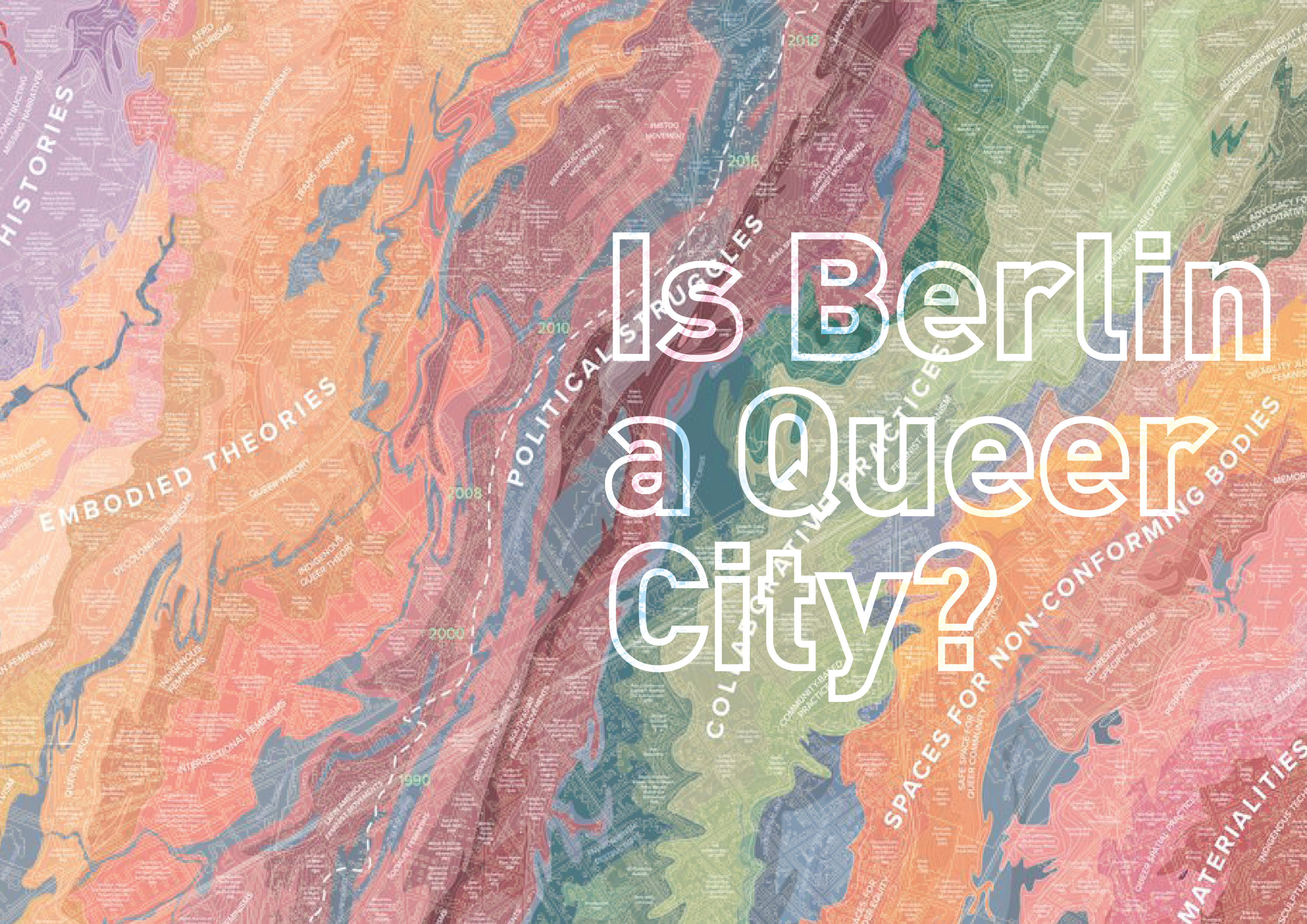
By various accounts, the city of Berlin is widely regarded as one of the queer capitals of the world. Numerous maps produced by the City of Berlin, as well as by publications such as Siegessäule magazine, reinforce this claim through curated “queer maps” that mark milestone locations, neighborhoods, and nightlife venues. These spatial representations of queer cultural spheres are largely oriented toward the tourism industry and function as a form of urban branding that caters to market demands. As such, they can be understood as a representational mode that often carries ambiguous political meanings for queerness, serving neoliberal regimes of spatial production and reinforcing forms of homonormativity [1]
On the other hand, emerging queer architectural theory often approaches mapping through the queer subject as atlas, historical reconstruction, or archival practice in order to trace spaces that have disappeared due to precariousness within extractive urban systems or that have been co-opted by regimes of commercialization.[2] In this sense, queer maps can be understood as serving both functions: navigating the city through its historical layers while also engaging with contemporary spatial politics.
At the same time, queerness can also be understood through the tensions described by Samuel Clowes Huneke between the “neoliberal queers” of the present and the radical queer movements of the past[3]. These positions often exist in conflict and contradiction rather than within a single coherent queer map. Such fractures can already be observed in Berlin itself: in the existence of two pride parades, in the contrasts between different lesbian and gay housing projects, or in the spatial tensions between queer cultural centers and anti-queer peripheries.
This seminar is interested in addressing the complexities of queer representation in a more conflictual and intersectional manner. Its aim is to investigate how urban domains such as housing, leisure, labor, public space, nature, culture, and infrastructures of care might be imagined as queer counterparts to normative spatial orders, and what spatial and systemic forces enable or constrain these processes.
In this sense, the seminar does not aim to produce yet another “Queer Map of Berlin.” Rather, through overlapping and sometimes contradictory spatial narratives, it seeks to explore what Huneke describes as a pragmatic position—one in which radical and neoliberal forms of queerness coexist as equally visible yet contested elements of the urban landscape
- Trainer/in: Veljko Markovic
- Trainer/in ohne Editorrecht: Christian Georg Haid