
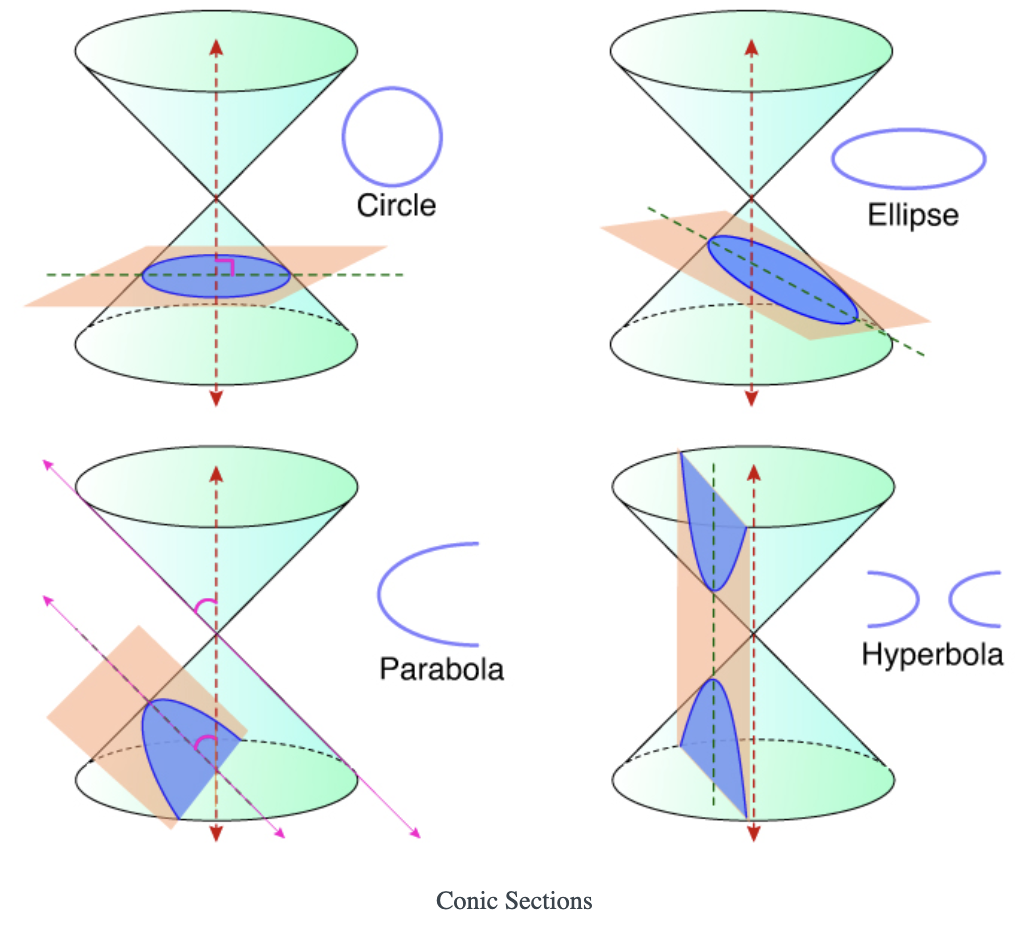
We begin by studying the most classical objects in algebraic geometry: conics and plane curves. We spend time playing with these examples to develop a feeling for how algebraic equations and geometric shapes interact and prove an early version of Bezout's theorem.
The central part of the course develops the theory of sheaves and schemes, which provide the natural framework in which to formulate and generalise classical results. We introduce morphisms of schemes and their fundamental properties, and study divisors and line bundles as fundamental tools for encoding geometric information. We then study the local structure of schemes, including objects such as differential forms.
We also introduce Čech cohomology, both as a computational method and as a bridge to more advanced cohomological techniques. The course concludes with the Riemann–Roch theorem.
Prerequisites
The course assumes prior knowledge of commutative algebra (as covered in Algebra II) and Galois theory (Algebra I). Some familiarity with manifolds or submanifolds is helpful for intuition, but not essential.
Lecture
Thursday 12:00-14:00, MA 548
- Trainer/in: Dominic Oliver Brooks Bunnett