
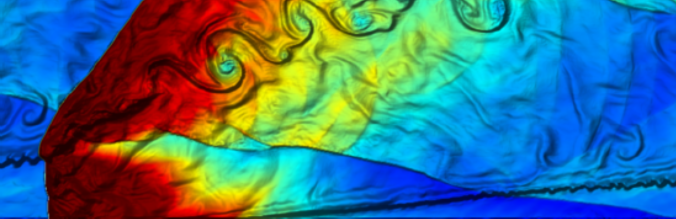
This course will provide an introductory overview to the new field of Pressure Gain Combustion (PGC), with a special focus on the cutting edge technology of Rotating Detonation Combustion. Students will gain familiarity with the fundamental concepts underlying PGC and RDC technology as well as the challenges being addressed and the techniques being used to advance these state-of-the-art combustion devices.
4 SWS (6LP), Language: English
NOTE: In SoSe 2025, this course will be held as a block course composed of a lecture period and a project period. The lecture period is tenatively scheduled for 28.07.25-08.08.25 and the project period extending up to 30.09.2025. Final dates to be scheduled soon.
Contents
- Fundamentals of deflagration combustion, including key concepts of laminar and turbulent burning velocities and flame propagation mechanisms.
- Fundamentals of detonation combustion, including key concepts of Rankin-Hugoniot relations, detonation theory, structure, phenomena, and deflagration-to-detonation transition (DDT).
- Fundamentals of compressible gas dynamics, including key concepts of normal shock relations, supersonic flows, nozzles, and shock wave reflections.
- Thermodynamics of heat release processes, and differences between constant pressure and pressure gain thermodynamic cycles.
- Applications of pressure gain combustion devices.
- Focus on rotating detonation combustion, including key concepts of canonical operation, phenomena, and design.
- Experimental methods in PGC: measurements of combustion wave speed, pressures, temperatures, thrust, and performance.
- Future research challenges in PGC and open questions.
- Trainer/in: Myles Bohon