
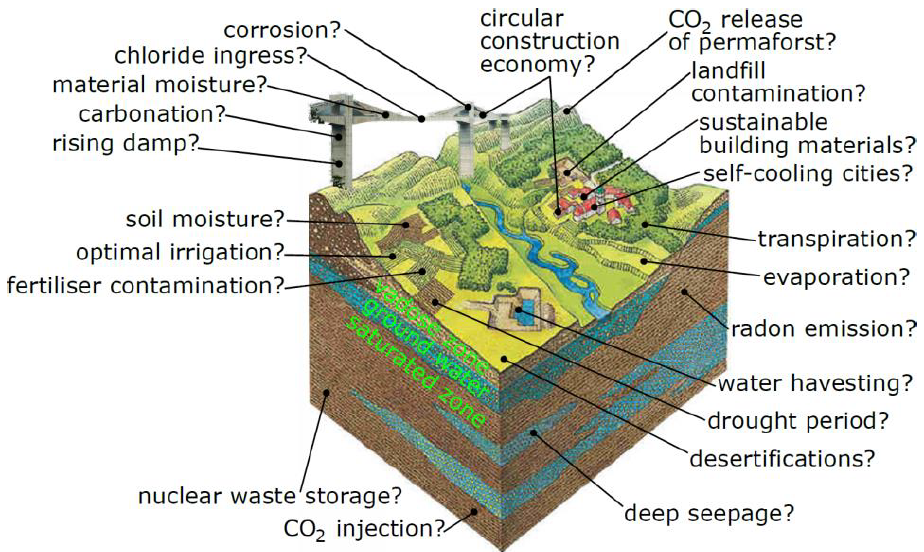
Objectives:
This lecture should give an overview over the modelling of mass transfer in porous media, such as soils or building materials. Furthermore, experiments will be conducted to measure and quantify transport properties such as the diffusion coefficient, hydraulic conductivity, sorption isotherms.
Background:
In 2020, the global human-made mass exceeded all living dry biomass. Since 1900, this increase of so-called anthropogenic mass is growing exponentially. The biggest share of ~40 % is represented by concrete, followed by aggregates with ~35 % and bricks with ~10 %. Plastic and asphalt contribute additionally with almost 10 %. In fact, more than 95 % of the anthropogenic mass consists of hydrophilic porous materials. Nevertheless, the much bigger source of porous material is our earth ground. Soils, rocks, sand, minerals, clay, sandstone, etc., they all represent hydrophilic porous media as well. Droughts are expected to increase in occurrence between 22 % to 123 %, with increased spatial extend and duration. In 2050, more than half of the population (52 %) will live under stressed water resource conditions. Facing these problems is important for sustainable future. Therefore, advanced modelling of diffusion and hydraulic conductivity is essential for a deeper understand of porous media, i.e., our environment.
- Trainer/in: Christoph Strangfeld