
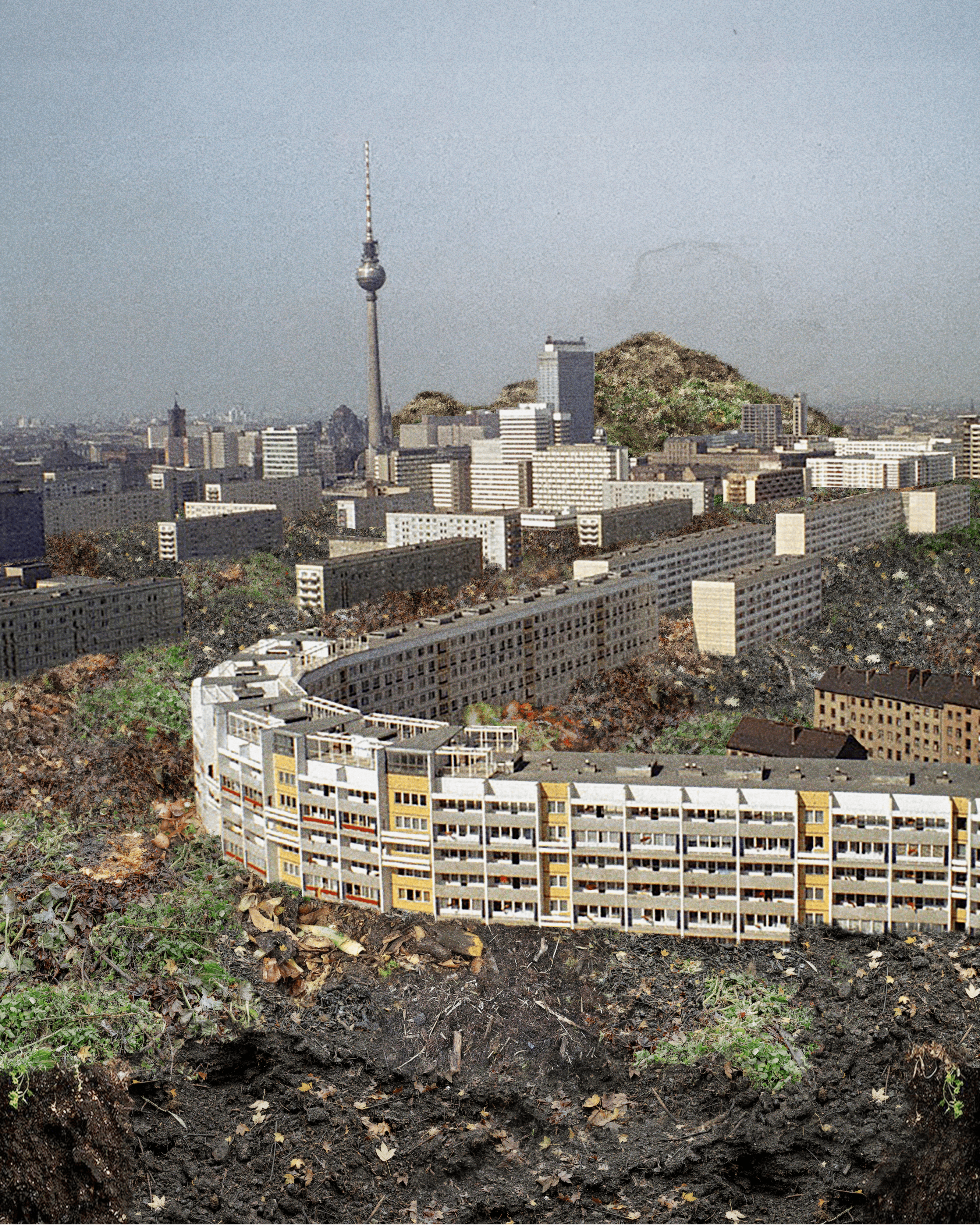
Across natural and cultivated spaces, but also in inhabited areas, soils form a thin, fragile and dynamic layer at the interface of the geo-, bio- and atmospheres. By infiltrating water, cooling the air, growing food, acting as carbon sink and supporting biodiversity, they provide crucial ecosystem services for global mitigation and local adaptation to climate change. The Chair of Transitioning Urban Ecosystems (CUE) is therefore committed to develop design strategies for URBAN SOIL preservation and regeneration through the ecological transition and sustainable requalification of metropolitan areas.
In collaboration with the master students of the Institut für Stadt- und Regionalplanung at TU Berlin (Prof. Jan Polivka), this design studio offers the opportunity to take part in a transdisciplinary research-by-design project for a soil-based and climate-oriented urban regeneration of Adlershof in Berlin, one of the largest science and technology park in Germany, currently facing various issues of sustainability. During the semester, a series of design assignments will help students to gradually engage with the fundamental concepts and processes of urban ecological design. By iterating radical, utopian ideas for living with soil, performing cross-scalar mapping, defining various spatial and metabolic design strategies, and conceiving novel typologies of urban habitats, the objective is to build a prospective atlas of urban regeneration in Adlershof.
- Trainer/in: Aniella Sophie Goldinger
- Trainer/in: Sarah Maria Möller
- Trainer/in: Antoine Vialle
- Trainer/in: Michel Zalis