
Kurzy
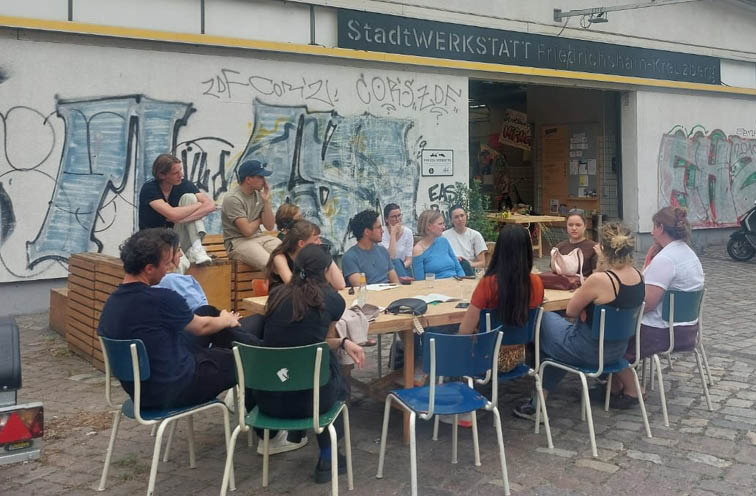
The Rathausblock is an urban renewal area in Berlin-Kreuzberg. Emerging from more than a decade of struggle by urban activists, a cooperative model project has developed between the city administration and civil society. The project is currently in its development phase and highlights both the socio-political challenges and potentials of co-production. How can communication succeed between such different actors? How can we overcome diverse organizational and power structures to enable inclusive, balanced, and productive exchange?
In this three-day workshop, we will explore this case through hands-on exercises and socio-spatial site investigations. We will reflect on how affordable spaces for living and working, as well as social and cultural places, can be created with the common good in mind – while thinking beyond the often resigned approach of “Realpolitik” in urban development. As an introduction to the case study, we will also have online sessions with invited guests, as well as in-person visits to other exemplary projects in the Berlin context. In doing so, we will gain in-depth insights into the current state of urban co-production in a European capital city that is currently engaging with these socio-political questions in particularly intensive ways. In conclusion, students will be required to produce a small documentation that offers both a reflection and a direct contribution to the ongoing development of the Rathausblock.
- Trainer/in: Maria Dannecker-Ryall
- Trainer/in: Jeanne Olive Lacour
- Trainer/in: Lorenza Manfredi
This semester, the Bachelor Studio Straßenarbeit examines the entangled meaning of the street itself. It challenges its conventional role in our practice: as infrastructure for transit, as a byproduct of urban planning, and/or as public space for both physical and social connectivity. Instead, the studio approaches the street as an architectural project in its own right. What if the street itself performs the work of shaping the modern citizen or political subject? What if everyday life unfolds as a performance on a stage whose spatial characteristics, programs, and surrounding façades can only be understood as an architecture of mise en scène?
Not every street is conceptualized and conceived in its entirety as a complete project. Karl-Marx-Allee in Berlin is one of those rare examples, where the street unfolds as a space between architecture and the city, simultaneously negotiating both while asserting its own presence. Stretching along an east–west axis in the former center of East Berlin, the street-project can be read longitudinally through its U-Bahn stops, plazas, and representative buildings. At the same time, it can also be understood as a project in its entirety dissected like the floor plans of a tower, without a clear top or bottom.
In the studio, we will divide the street into working quadrants, where each group will engage in mapping, documenting, interpreting findings, and identifying contradictions that will later inform their design proposals. This segmentation will expose the street’s fragmented nature less an ideological totality, as it was originally conceived, and more a collage of layered histories.
- Trainer/in: Maria Dannecker-Ryall
- Trainer/in: Veljko Markovic
- Trainer/in: Franka Matthes
- Trainer/in: Joschka Sina Schaper