
Kurslar
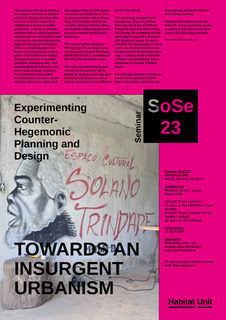
Towards an Insurgent Urbanism
Experimenting counter-hegemonic planning and design
This Seminar is a development of the Seminar Counter Hegemonic Spatial Practices from the WiSe 22/23 and is connected to the COLLOC Workshop-series. It intends to develop and explore theoretical debates as well as design practices that focus on counter-hegemonic collaborative forms of spatial production. It seeks to provide students with a critical approach towards the role of architects and urbanists in city development by experimenting and developing skills in transdisciplinary methods and collaborative work in urban and architectural design. Through exposure to complex problems, activating inter- and transdisciplinary networks, and discussing strategic solutions for sustainable and resilient transformations in urban space, students will access skills that will support them in their professional and academic lives. This is also associated with a deepening of knowledge transfer on complex global problems, directed towards methodological and practice-oriented North-South exchange.
Connected to the Seminar, the COLLOC workshop will have the participation of students, activities and dwellers from Brazil, as well as experts and Alumni from different parts of the World. The workshop will happen in two Phases: Phase 1 (online) from Sep 1st to 3rd and Phase 2 (hybrid) from Sep 22nd to Oct 1st. During the workshop we will work empirically with a Brazilian self-organized squat and the students will be offered the opportunity to travel to Rio de Janeiro/ Brazil to experiment on site the Dual Design strategy by building small scale interventions and develop future scenarios for Solano Trindade squat. A limited number of students will be partially funded (more information about the funding options will be provided in the coming months).
Detailed information about the COLLOC series workshop can be found here and videos from previous COLLOCs here and here.
- Trainer/in: Juliana Soares Gomes Canedo
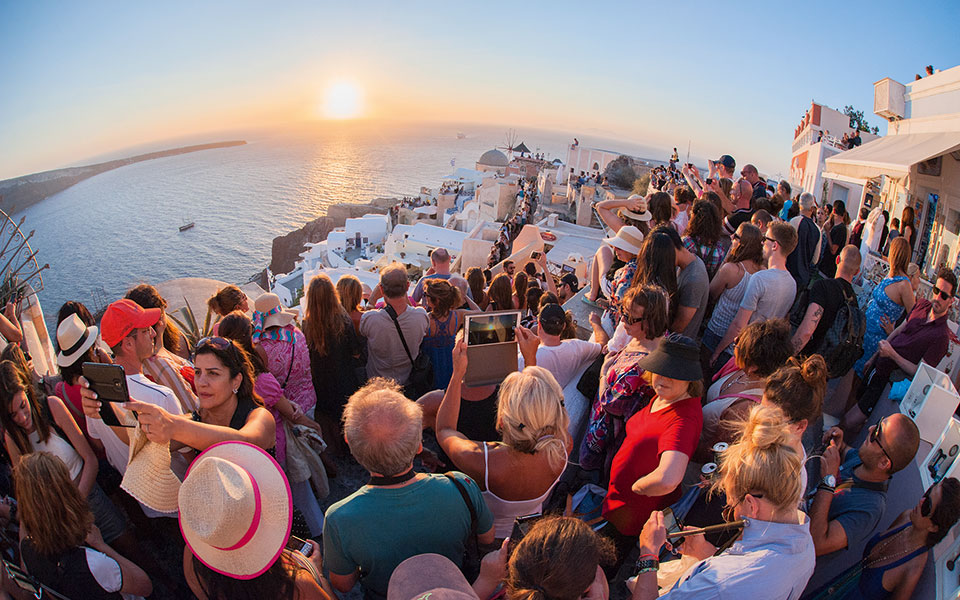
Amorgos Flux: Water, Tourism, Climate Change
Due to its vast number of world heritage sites and the long coastline Greece is one of the most visited countries in the world, making tourism the nation’s principal economic sector. In the last decade, some of the islands in the Aegean Archipelago have evolved into the most frequented holiday destinations globally. Their blue waters and romantic harbor towns, the islands' warm, dry Mediterranean climate and relatively exclusive tourism have brought thousands of guests from around the world, with a continued prospected upward trend in the near future.
Many of the arid islands have evolved into urbanized tourist destinations influenced by global and national economic and political developments that transformed these regions in unprecedented ways, reshaping the underlying social, economic, and infrastructural dynamics of the entire archipelago. As a result, the islands are held together by intricate systems of flows and infrastructures, a unique density and diversity of currents, identities, and connections.
Cruise tourism, geopolitical tensions between Greece and Turkey, global migration routes, European energy expansion goals, invasive species, and global climate change are some of the transformative forces shaping the region with significant ecological and social consequences.
Infrastructure logistics are seasonally overloaded since all goods and necessities need to be imported from the mainland. Furthermore, consequences of climate change and increased touristic activities result in irreversible damage to the island landscapes and directly impact on commercial, economic, and social relationships between the islands and the mainland. Moreover, water scarcity is one of the most pressing issues, as most islands have no or only inadequate groundwater resources and are relying solely on rainfall. Importing freshwater is expensive due to the long distances involved and is not sustainable with the exploding numbers of part-time residents and tourists.
The studio will focus on the island of Amorgos on the eastern rim of the Cyclades and investigate its constitutive systems and flows of goods, materials, people, water, energy. Students will gain a deep understanding of the region's history, ecology, culture, and economy, as well as the social and environmental factors that shape the islands today. In a first stage groups will study the inflow and outflow of material cycles to prepare for a 10 day field-trip. On site in Amorgos, the groups investigate specific infrastructure systems and their history with the help of interviews, drawings and mapping in Geobased Information System (GIS). After these extensive analysis processes, in a third phase, groups will develop speculative scenarios that will project current developments into future touristic and urban transformations.
The studio will be accompanied by a field-trip in early June. Costs have to be covered by the students.
- Trainer/in: David Bauer
- Trainer/in: Anke Hagemann
- Trainer/in: Christian Georg Haid
- Trainer/in: Aikaterini Tzouvala
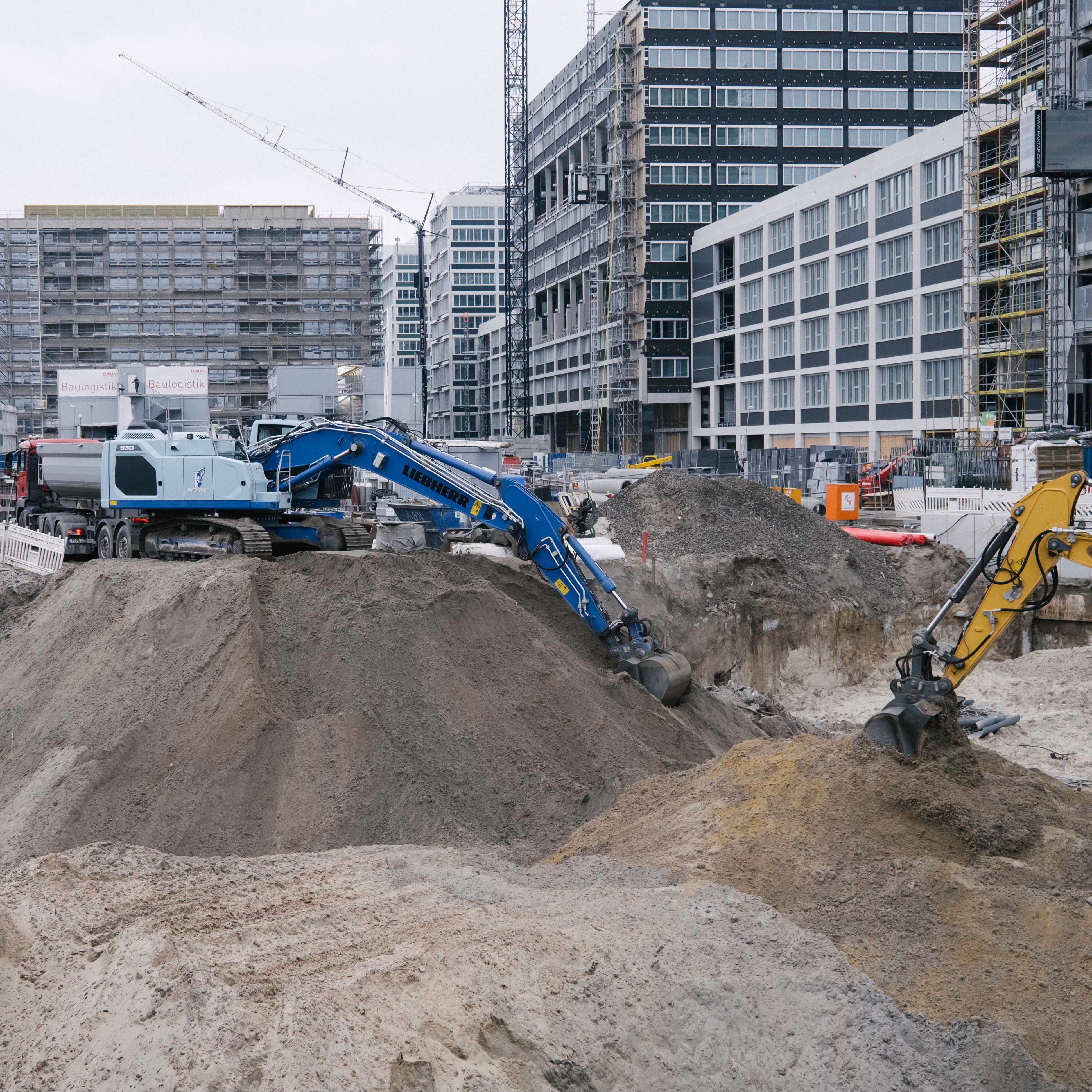
Urban Earth Blocks
Experiential Transformations of Mineral Waste Streams
Contemporary architectural production requires the replacement of soil in the city. Earth is pushed out of the ground and replaced by foundations, parking spots and subway stations. On the fringes, the excavation material from the cities is deposited in the craters left by sand and gravel mining. The wasteful consumption patterns of our times allow this linear displacement of geogenic minerals without hesitation. We may speak of ‘cheap nature,’ a term coined by Jason Moore, which describes the undervaluing of nature, in which products plundered from the natural environment are priced only for their cost of extraction and transportation. As the acceleration of the climate crisis renders a paradigm shift in our treatment of nature inevitable, we must explore new ways to incentivise a revaluing of ‘cheap nature.’
In cooperation with Bauhaus Earth, an organisation working on researching and demonstrating regenerative solutions for the built environment, this seminar will explore the linear supply chains of mineral building materials. Together, we will track the flow of fresh materials from Brandenburg’s sand- and gravel mines to the city and the return of excavation material from the city to the hinterlands. The first part of the seminar will be taught as reading-based discussion sessions that draw from philosophical approaches to a critical questioning of current consumption and waste management patterns. The first part will conclude with a visit to a large-scale sand mining site.
In the second part of the semester, students will practically engage with circular transformations of excavation material into building materials. We will experiment with soil from different construction sites to understand their suitability as a building material. During the practical phase students are asked to contribute with short presentations on different topics ranging from soil contamination and soil testing to material production and quality control. This practical work will result in the transformation of excavation material into compressed earth blocks that will be demonstrated in a prototype building in Potsdam.
- Trainer/in: David Bauer
- Trainer/in: Christian Alexander Gäth
- Trainer/in: Micha Jonathan Kretschmann
- Trainer/in: David Bauer
- Trainer/in: Anke Hagemann
- Trainer/in: Juliana Soares Gomes Canedo
- Trainer/in: Aikaterini Tzouvala