
Kurzy
LIVING CITIES /2 – REIMAGINING ARCHITECTURES BY CARING FOR INHABITED MILIEUS
The aim is to explore the regenerative capacities of living milieus amidst new ecologies that attempt to overcome the opposition between nature and culture and anthropocentrism during times marked by natural disasters and a climate emergency.
How can we care for inhabited milieus?
The increasingly alarming nature of the different IPCC reports, most recently that of March 2022, and the COVID-19 pandemic with its planet-wide impact, have made the vulnerabilities of the living world and the metamorphoses of habitability even more starkly apparent. The very possibility of living is now in doubt for all, given the excessive consumption of natural resources by certain human groups to the detriment of the needs of the global population, exceeding what planet earth can replace.
Climate emergency, overexploitation, pollution, inequality and iniquity – all these ills, upheavals and disorientations demand actions of “care” that address the coexistence and interrelationship of all the elements of the living world, and thus mandate a radical shift in paradigm. Sensitivity, responsibility, creativity are aspects of care and of interest in other beings.
This demands an awareness of the affiliations and interactions at work in the situations put forward for the competition. For Europan 17, the contexts demand a radical change towards a more immersive approach to the conception and production of space, an approach founded in care for living milieus. A new paradigm is at work, prompting us to wonder how to reconcile things and beings at a time when the habitability of Planet Earth is in question. Local and translocal strategies are be associated both with issues of metabolism (new ways of managing flows of natural elements, materials and human beings with the aim of developing circular economy) and issues of fairness and solidarity (inclusivity of actors in processes) which were already partially operative in certain contexts in E16.
Reimagining architectures that are embodied in “visions” or “narratives” of the evolution of sites between present and future.
In response to these territorial challenges, it is more than necessary to create complex, global and dynamic spatial reconfigurations in damaged inhabited milieus in order to revitalise biological and human communities. The care-based approach will lead to a necessary interplay of innovative, dynamic and varied project processes:
- producing an active understanding of what is already in place (biological + socio-anthropological scales), a situational intelligence;
- on the basis of this immersion, repairing mistreated territories/spaces by subtraction and recreation;
- reinforcing, regenerating or creating qualities of hybridisation between nature and culture;
- linking the scale of strategic and dynamic reflection on territories (the large-scale structuring ecological challenges) with the scale of local spaces and their re-conception (everyday spaces and shared spaces);
- imagining/creating spaces today with a view to the connection between present and future and therefore their production and adaptability over time (sustainable development);
- tackling projects with a readiness for design and production processes that involve all actors with their diversity and their differing roles.
In order to achieve this complexity, the situations that will be chosen for the Europan 17 competition must be such that the projects submitted can activate in different contexts and at different scales:
- symbiotic links between the living world and the cultural world, vital relations between human and nonhuman beings;
- spatial synergies (actions conducted in concert between different elements, entities or stakeholders): these are types of natural and cultural re-liances at different scales between elements that have become fragmented as a result of the modernist development of milieus;
- natural and human temporalities (cycles and rhythms of the living world and the social world) in process-projects.
The STUDIO will work on the BARCELONA case:
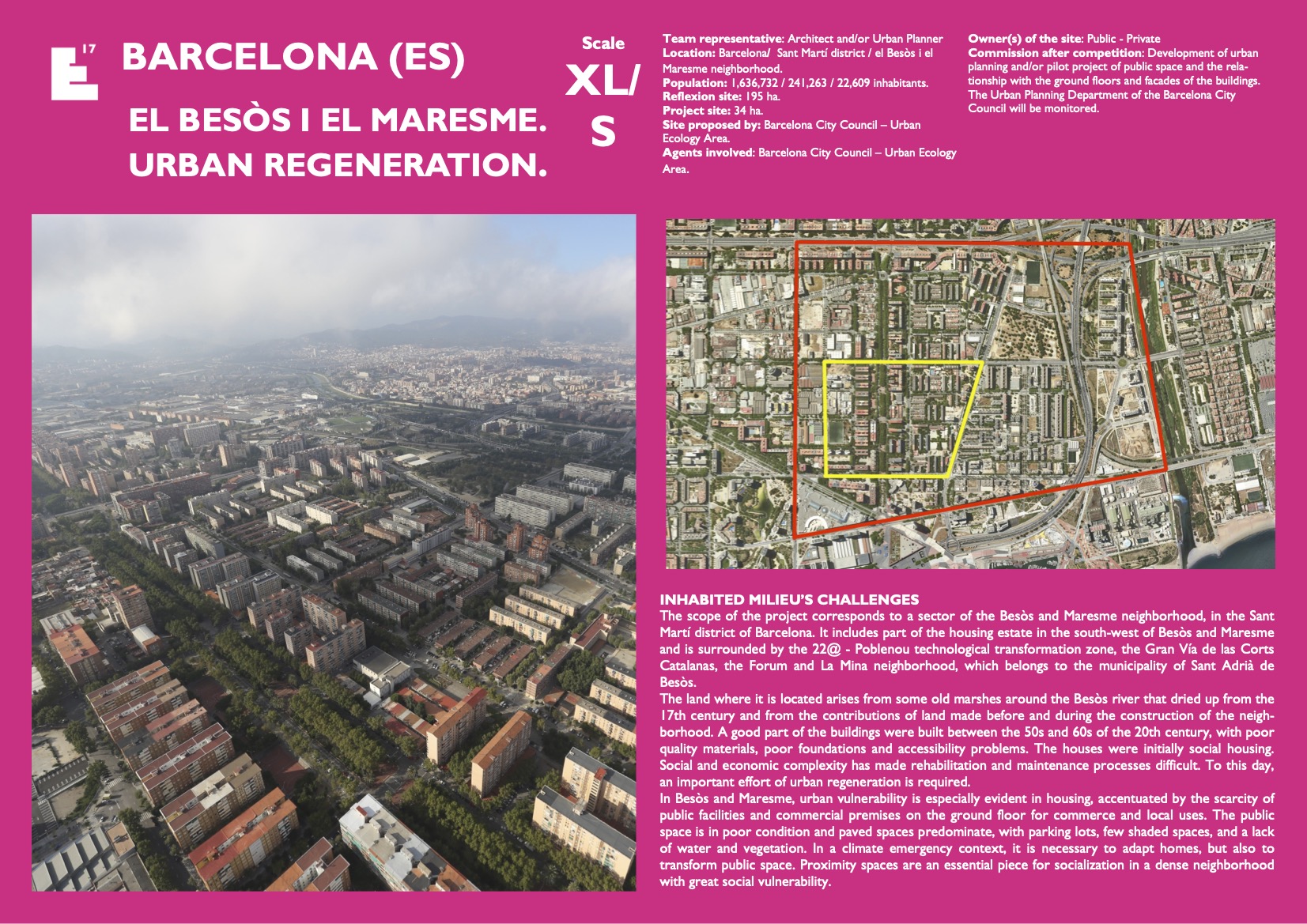
The site includes the two dimensions of nature (natural elements) and culture (inhabited spaces) and combines two scales:
- the territorial and geographical scale of the “reflection site” (delimited with a red line and which raises the big issues around ecology, mobilities and must be taken into account by the competitors and where they can propose ideas of evolution...)
- and the proximity scale of the “project site” (delimited with a yellow line and which may range from a single building and its immediate environment to larger fragments where the architectural project links in with the wider territorial scale).
PROJECT / STUDIO WORK
The course is explicitly aimed at students with design experience (i.e. design-basics are NOT part of the course curriculum). Students will work in small groups which will have a high degree of independence. The groupwork is framed by a joint kick-off session, the excursion* and concluding presentation(s). At the beginning of the semester, the necessary basics are worked out together (e.g. in the form of infographics and presentations). At the end of the semester, overall findings of the design work are jointly reflected and prepared for the project bazaar at ISR (including a written report).
* In the week of May 8-12 th we will offer an excursion to Barcelona as part of the project/studio.
- Trainer/in: Andreas Brück
- Trainer/in: Pierre Niclas-Yannic Funcke
- Trainer/in: Georg Müller
„Stadt- und Regionalplanung? Raumplanung? Das kann man studieren?“ Diese Fragen kennen wahrscheinlich viele von uns. Die einfache Antwort: „Ja! Es gibt sogar vielfältige und vielseitige Berufswege“ Die Bandbreite und der Berufsalltag sind Gegenstand des Berufspraxisseminars.
Im Berufspraxisseminar wird als Pflichtbestandteil des Moduls BERUFSPRAXIS ein breiter Überblick über die verschiedenen Berufspraxisfelder und Arbeitsalltage in der Stadt- und Regionalplanung und ein Einblick in die Praxiswelt gegeben. Die Bandbreite der Berufspraxis wird mittels thematischer Fachvorträge – den ISR Sommergesprächen – durch Externe (aus öffentlicher Verwaltung, privaten Unternehmen und Büros, Verbänden und Institutionen) vorgestellt. Anhand skizzierter Projekte und Themen zum Stand von standplanerischer Praxis und Forschung werden mögliche Arbeitsfelder erörtert und Berufsbiografien und -wege diskutiert.
- Trainer/in: Andreas Brück
Projektarbeit kennt man aus vielen Lebensbereichen: beim Heimwerken, beim Studium, usw. Überall begegnen uns Projekte – der Begriff wird beinahe inflationär gebraucht. Es gibt Projekte in der IT, im Maschinenbau, im Verlagswesen, bei Versicherungen und Banken, bei NGOs, in der Sozialarbeit und anderswo. Auch in der Stadtplanung bzw. im Berufsalltag von Stadt- und Regionalplanerinnen ist Projektarbeit an der Tagesordnung.
In der IV zu Projektarbeit & Projektmanagement werden theoretische und praktische Grundlagen vermittelt, unterschiedliche Management-Tools und -Methoden diskutiert, Herangehensweisen bei der Teamarbeit erörtert (z.B. Projektrollen sowie die Zusammensetzung und Hierarchie von Projektteams), Lösungsmöglichkeiten in Konfliktfällen besprochen, komplexe Schwerpunktaufgaben von Projekt- und Routineaufgaben abgegrenzt und wichtige Bereiche wie die Stakeholderanalyse sowie die Ressourcenplanung vertieft.
Anhand praktischer Bezüge und eines hand-on Praxisbeispiels wird – basierend auf der Vermittlung des „klassischen“ Projektmanagements als Steuerungsprozess – erprobt, inwieweit sich theoretischer Ansatz und praktische Durchführung decken.
- Trainer/in: Andreas Brück
- Trainer/in: Andreas Brück
- Trainer/in: Pierre Niclas-Yannic Funcke
- Trainer/in: Georg Müller
Urban Mobility: Urban Streets as Urban Commons
When car-use becomes restricted on streets, is that called opening or closing a street? The conflict around this question currently splits Berlin. As the automotive city planning paradigm of much of the twentieth century rolls out bumpily, many are ready to replace it with a paradigm that puts people instead of cars first. The claim is that the urban street of the future is not merely a transit space, but rather part of the urban commons, a space that is there for everyone to use. Climate mitigation, space justice, and mobility justice all play a role here as well.
In this seminar, we will look at urban (street) space as urban commons, discuss the change of meaning that street space has undergone in the past and still undergoes and get a first-hand experience of the conflict described above by visiting reclaimed spaces and conducting interviews. We will also deal with specific examples of street reclamations worldwide.
Participants are expected to do a case study report, a short presentation, participate in the readings and the discussions and contribute to the field research. The seminar is in presence and includes field trips within Berlin (which do not count for an Exkursionsbescheinigung, unfortunately).
The seminar is scheduled on Mondays from 14-16. The sessions on 22/5 and 19/6 will likely be from 14-18, the sessions on 26/6 and 3/7 will not take place. The main language will be English, however, some contributions will be in German. The first session is on 17/4.
- Trainer/in: Felicitas Blanco Hähn
- Trainer/in: Felicitas Blanco Hähn
- Trainer/in: Andreas Brück
- Trainer/in: Fabian Benjamin Deter
- Trainer/in ohne Editorrecht: Andrea Bluhm