
Kursy
Seminar
Counter Hegemonic Spatial Practices
Learning from Experiences in the Global South
The Seminar combines theoretical inputs and practical activities in the topics of informality, self-organized spaces through the lens of collaborative design approaches. It seeks to provide students with a critical approach towards the role of architects and urbanists in city development using experiences in the Global South to build bridges and dialogues with the Global North.
The goal of the Seminar is for students to experiment and develop
skills in transdisciplinary methods and collaborative work in urban and
architectural design. Through exposure to complex problems, activating
inter- and transdisciplinary networks, and discussing strategic
solutions for sustainable and resilient transformations in urban space,
students will access skills that will support them in their professional
and academic lives. This is also associated with a deepening of
knowledge transfer on
complex global problems, directed towards methodological and practice-oriented North-South exchange.
During the Seminar we will work empirically with a
Brazilian
self-organized squat and the students will be offered the opportunity to
travel to Rio de Janeiro/ Brazil to experiment on site the Dual Design
strategy by building small scale interventions and future scenarios for
Solano Trindade squat. The Excursion will be from November 11th to 20th
2022 and the students might be partially funded (more information about
the funding options will be provided by the end of September). Students
who
cannot fly to Rio de Janeiro will be able to participate online.
It is connected to the international Alumni workshop COLLOC 2022 - Collaborative Production of Transformation Knowledge in self-organized occupations.
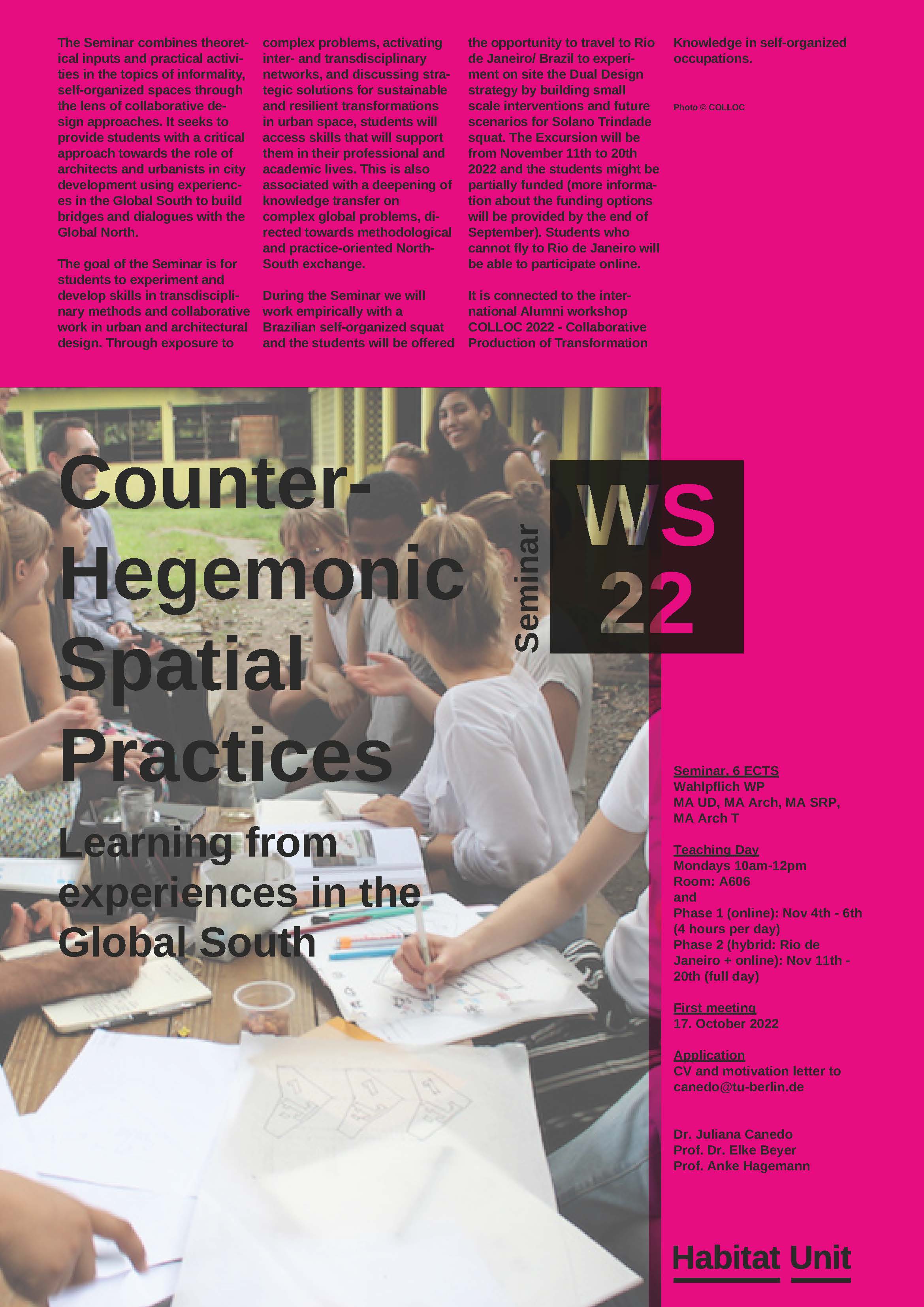
Photo © COLLOC
- Trainer/in: Anke Hagemann
- Trainer/in: Juliana Soares Gomes Canedo
Seminar
City of Queer Spaces II - Oral Histories
In this seminar, we will detect and analyze forgotten, disappeared, and displaced queer spaces in Berlin and elsewhere and explore why many of these places no longer exist, yet significantly resonate in the queer community’s memory.
We will track down, archive, and map these places. We will explore
the ways in which queer infrastructures play a role in urban
transformation processes and how they can be an essential part of
producing a more inclusive and equitable city. Queer life and its spaces
are comparatively poorly documented and archived, which is why a
significant part of the research will be devoted to opening up new
sources (e.g. historical city guides, oral histories, sources from
LGBTQI+ institutions).
The outcome of the second part of this
seminar will be predominantly audio features of oral histories of queer
places that no longer exist. The research of queer places in Berlin will
be accompanied by readings and discussions on queer urbanism and the
theories of counter-archives. In topic-specific inputs, lectures by
guests, in film screenings and via pop-cultural sources, references to
contexts beyond Berlin will be made.
The seminar will be held in English however a basic knowledge of German is beneficial in order to conduct the oral histories interviews.
The results of the seminar are embedded in the artistic research project „Nothing that ever was changes“ by POLIGONAL Office for Urban Communication.
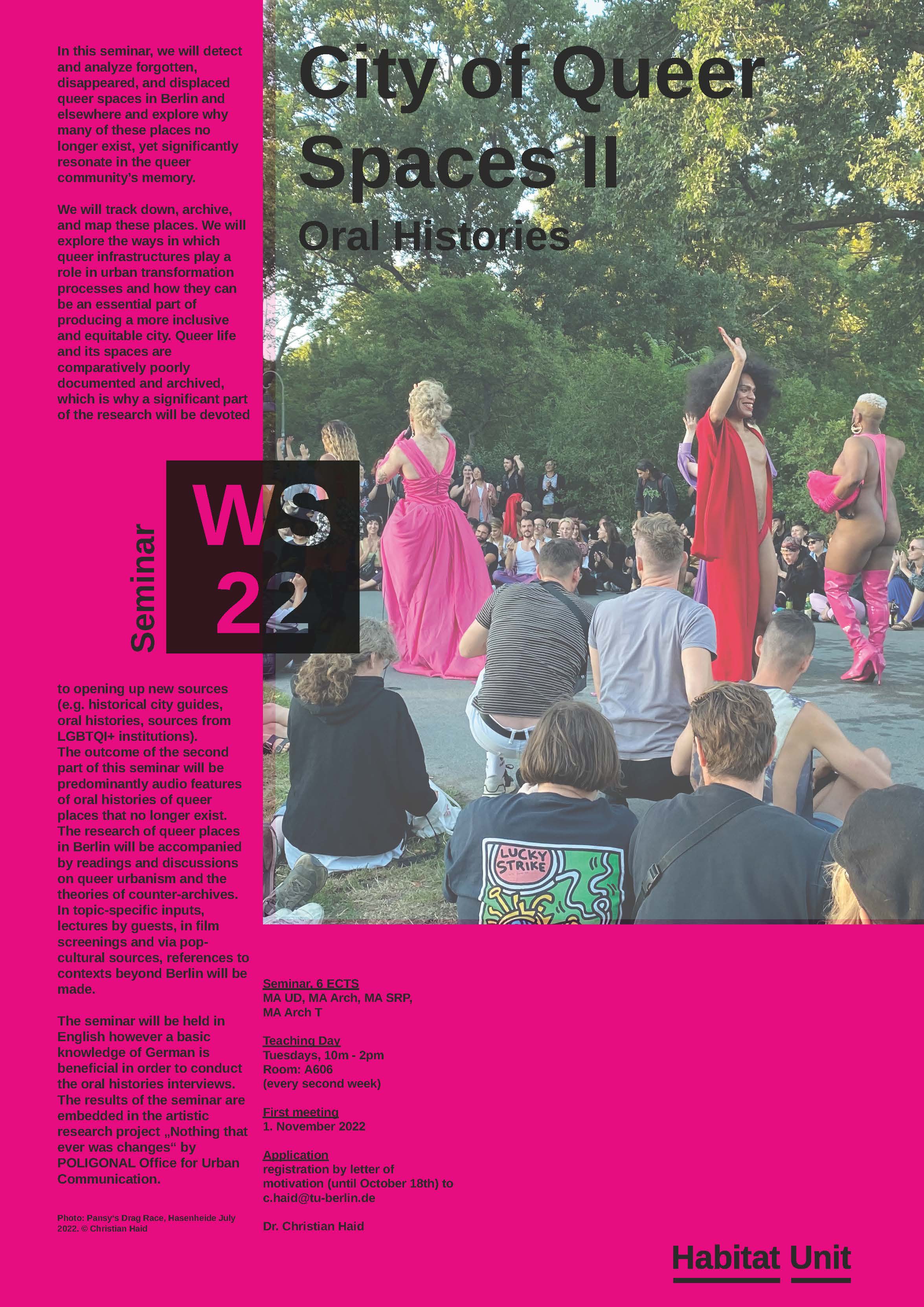
Photo: Pansy‘s Drag Race, Hasenheide July 2022. © Christian Haid
- Trainer/in: Christian Georg Haid
Global City Local Spaces
This lecture series will focus on different theoretical and analytical approaches to urban settlements, global urbanisation and transformation as well as on the practice of urban planning. It is structured in three blocks, addressing key questions such as: How can one define the urban as a field of inquiry and planning practice in a planetary perspective? How is the knowledge base of planning generated by different disciplines and across geographies of expertise and power? How can one build an understanding of the co-production of urban space as a toolbox for more inclusionary, sustainable and just planning and design strategies?
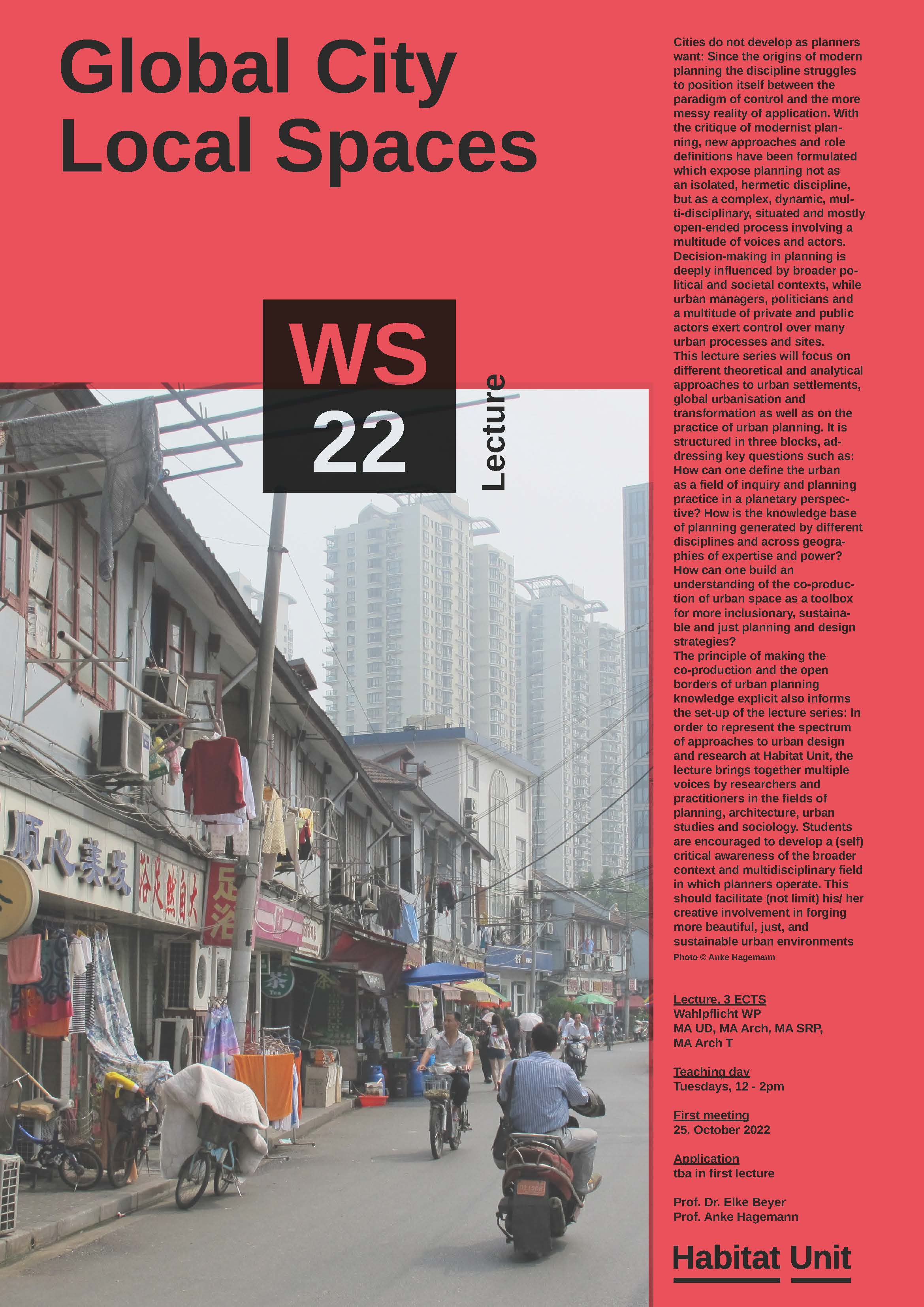
The principle of making the co-production and the open borders of urban planning knowledge explicit also informs the set-up of the lecture series: In order to represent the spectrum of approaches to urban design and research at Habitat Unit, the lecture brings together multiple voices by researchers and practitioners in the fields of planning, architecture, urban studies and sociology. Students are encouraged to develop a (self)critical awareness of the broader context and multidisciplinary field in which planners operate. This should facilitate (not limit) his/ her creative involvement in forging more beautiful, just, and sustainable urban environments.Photo © Anke Hagemann
- Trainer/in: Anke Hagemann
- Trainer/in: Aikaterini Tzouvala
Bachelor Entwurfsstudio:
BB2040 Urban River Scapes: Entlang der Panke.
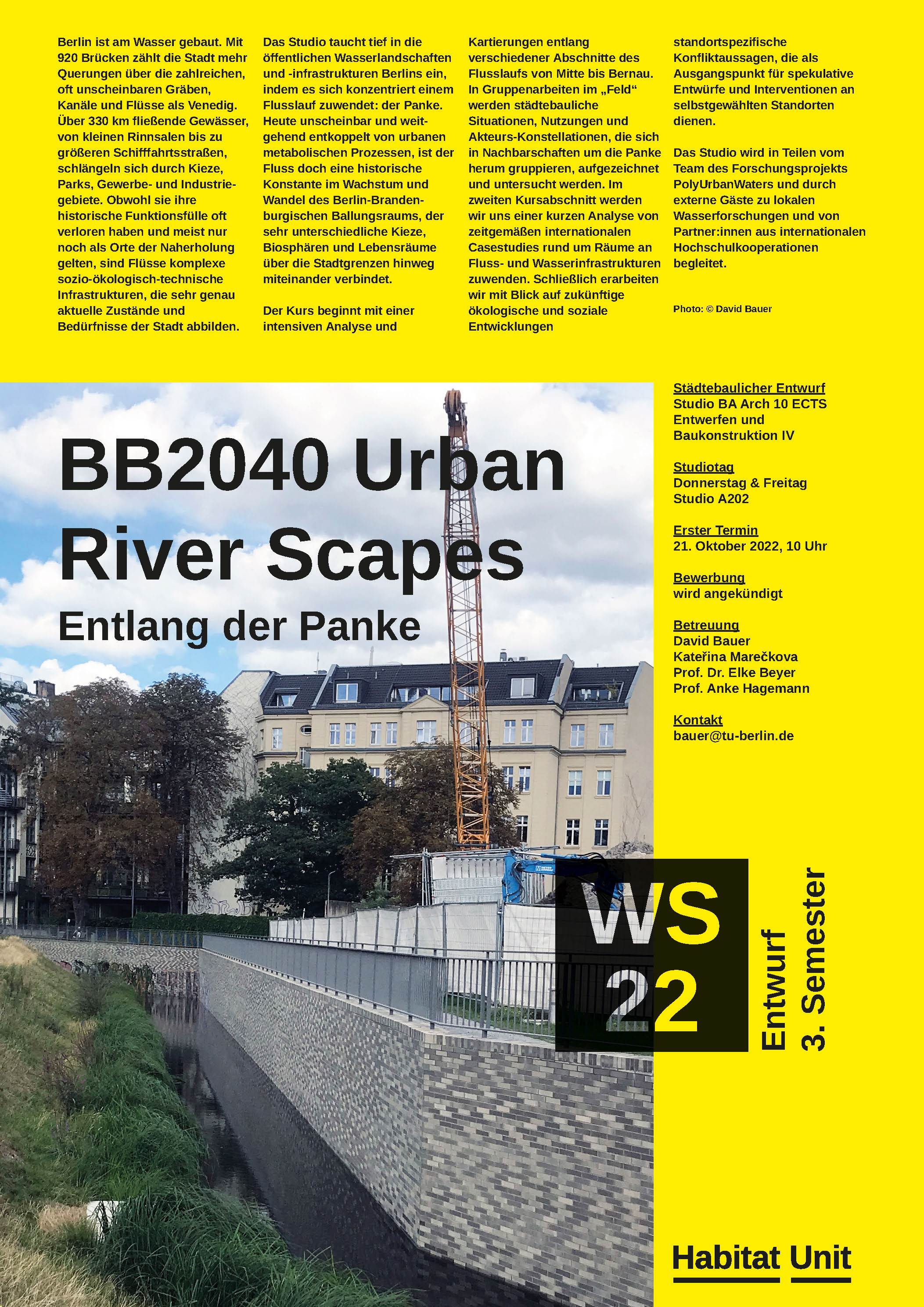
Berlin ist am Wasser gebaut. Mit 920 Brücken zählt die Stadt mehr Querungen über die zahlreichen, vielleicht oft unscheinbaren Gräben, Kanäle und Flüsse als die Lagunenstadt Venedig. Über 330 km fließende Gewässer, von kleinen Rinnsalen bis zu größeren Schifffahrtsstraßen, schlängeln sich durch Kieze, Parks, Gewerbe- und Industriegebiete. Obwohl sie ihre historische Funktionsfülle oft verloren haben und meist nur noch als Orte der Naherholung gelten, sind Flüsse komplexe sozio-ökologisch-technische Infrastrukturen, die sehr genau aktuelle Zustände und Bedürfnisse der Stadt abbilden.
Das Studio taucht tief in die öffentlichen Wasserlandschaften und -infrastrukturen Berlins ein, indem es sich konzentriert einem Flusslauf zuwendet: der Panke. Heute unscheinbar und weitgehend entkoppelt von urbanen metabolischen Prozessen, ist der Fluss doch eine historische Konstante im Wachstum und Wandel des Berlin-Brandenburgischen Ballungsraums, der sehr unterschiedliche Kieze, Biosphären und Lebensräume über die Stadtgrenzen hinweg miteinander verbindet.
Der Kurs beginnt mit einer intensiven Analyse und Kartierungen entlang verschiedener Abschnitte des Flusslaufs von Mitte bis Bernau. In Gruppenarbeiten im "Feld" werden städtebauliche Situationen, Nutzungen und Akteurs-Konstellationen, die sich in Nachbarschaften um die Panke herum gruppieren, aufgezeichnet und untersucht werden. Im zweiten Kursabschnitt werden wir uns einer kurzen Analyse von zeitgemäßen internationalen Casestudies rund um Räume an Fluss- und Wasserinfrastrukturen zuwenden. Schließlich erarbeiten wir mit Blick auf zukünftige ökologische und soziale Entwicklungen standortspezifische Konfliktaussagen, die als Ausgangspunkt für spekulative Entwürfe und Interventionen an selbstgewählten Standorten dienen.
Das Studio wird in Teilen vom Team des Forschungsprojekts
Poly-Urban Waters und durch externe Gäste zu lokalen Wasserforschungen und von
Partner:innen aus internationalen Hochschulkooperationen begleitet.
- Trainer/in: David Bauer
- Trainer/in: Luisa Paul