
Kurser
Integration through Collaboration
Transforming Spaces and Practices.
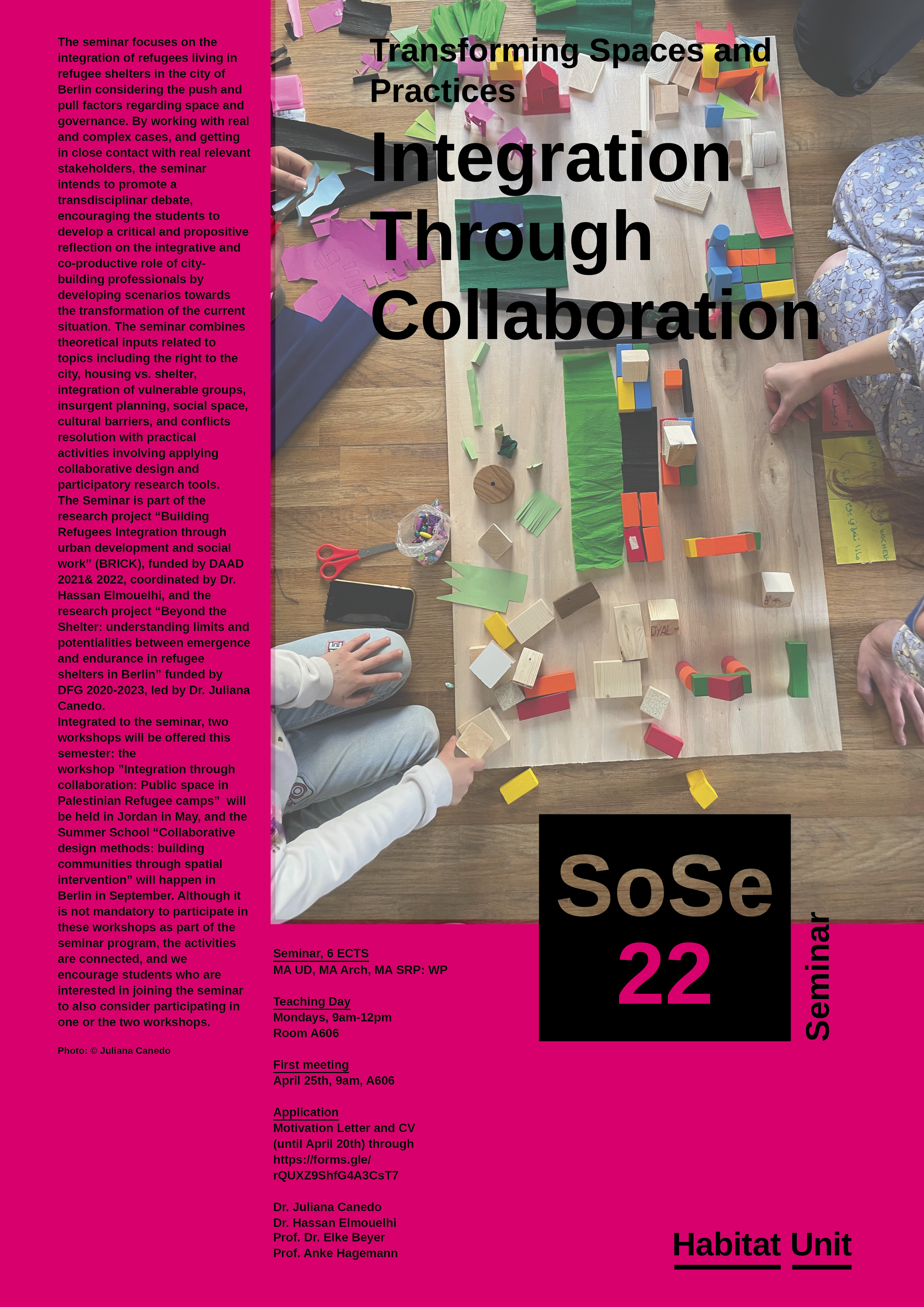
The seminar focuses on the integration of refugees living in refugee shelters in the city of Berlin considering the push and pull factors regarding space and governance. By working with real and complex cases, and getting in close contact with real relevant stakeholders, the seminar intends to promote a transdisciplinar debate, encouraging the students to develop a critical and propositive reflection on the integrative and co-productive role of city- building professionals by developing scenarios towards the transformation of the current situation. The seminar combines theoretical inputs related to topics including the right to the city, housing vs. shelter, integration of vulnerable groups, insurgent planning, social space, cultural barriers, and conflicts resolution with practical activities involving applying collaborative design and participatory research tools.
The Seminar is part of the research project “Building Refugees Integration through urban development and social work” (BRICK), funded by DAAD 2021& 2022, coordinated by Dr. Hassan Elmouelhi, and the research project “Beyond the Shelter: understanding limits and potentialities between emergence and endurance in refugee shelters in Berlin” funded by DFG 2020-2023, led by Dr. Juliana Canedo.
Integrated to the seminar, two
workshops will be offered this
semester: the
workshop ”Integration through
collaboration: Public space in
Palestinian Refugee camps” will
be held in Jordan in May, and the
Summer School “Collaborative
design methods: building
communities through spatial
intervention” will happen in
Berlin in September. Although it
is not mandatory to participate in
these workshops as part of the
seminar program, the activities
are connected, and we
encourage students who are
interested in joining the seminar
to also consider participating in
one or the two workshops.
- Trainer/in: Juliana Soares Gomes Canedo
BB2040 - Representing Infrastructure.
An Atlas of Berlin-Brandenburg up to the year 2040
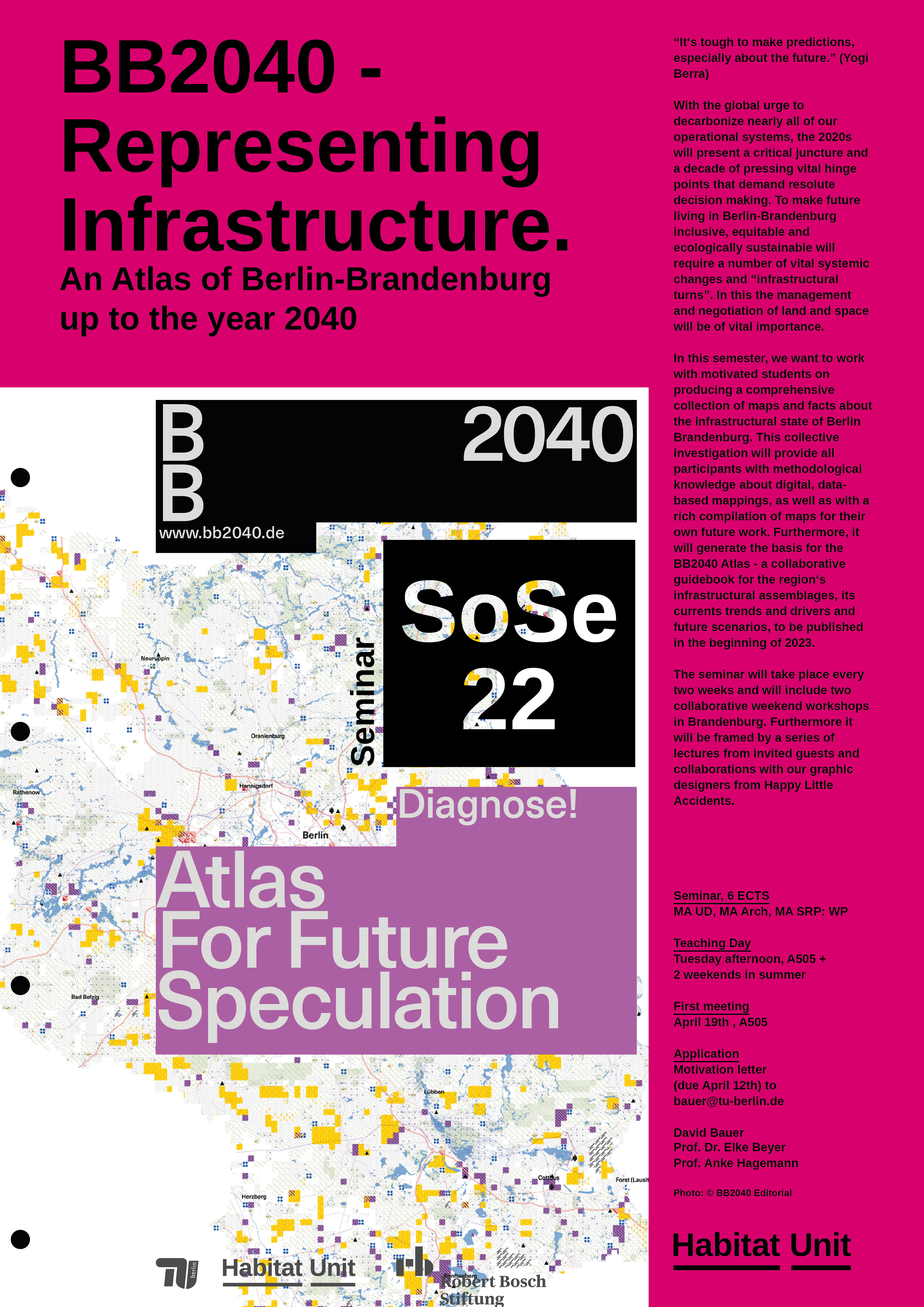
With the global urge to decarbonize nearly all of our operational systems, the 2020s will present a critical juncture and a decade of pressing vital hinge points that demand resolute decision making. To make future living in Berlin-Brandenburg inclusive, equitable and ecologically sustainable will require a number of vital systemic changes and “infrastructural turns”. In this the management and negotiation of land and space will be of vital importance.
In this semester, we want to work with motivated students on producing a comprehensive collection of maps and facts about the infrastructural state of Berlin Brandenburg. This collective investigation will provide all participants with methodological knowledge about digital, data-based mappings, as well as with a rich compilation of maps for their own future work. Furthermore, it will generate the basis for the BB2040 Atlas - a collaborative guidebook for the region‘s infrastructural assemblages, its currents trends and drivers and future scenarios, to be published in the beginning of 2023.
The seminar will take place every two weeks and will include two collaborative weekend workshops in Brandenburg. Furthermore it will be framed by a series of lectures from invited guests and collaborations with our graphic designers from Happy Little Accidents.
- Trainer/in: David Bauer
Safe(r) City? Safe(r) Housing?
Solidary Practices and Infrastructures for Queer-Feminist Housing in Berlin
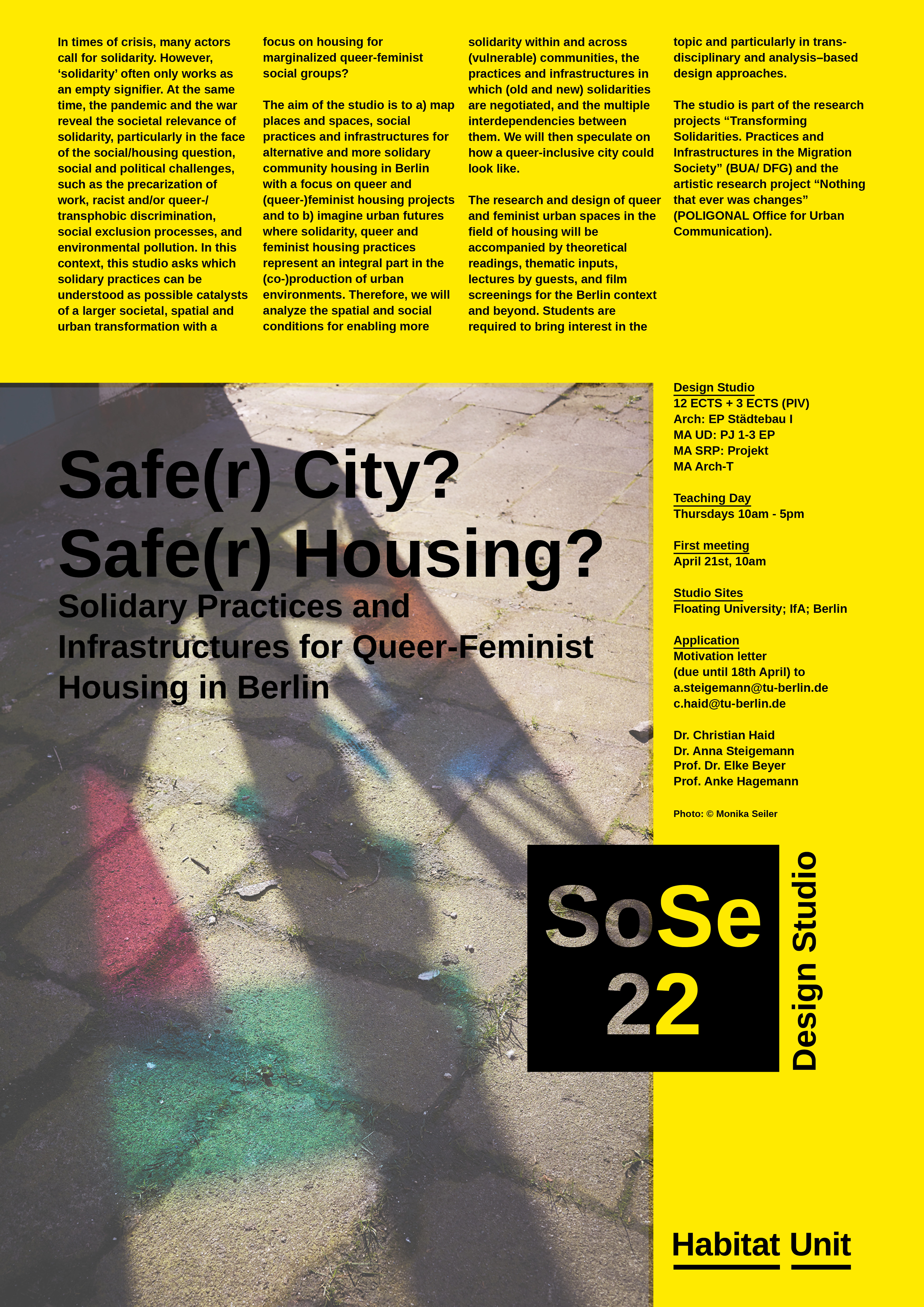
The aim of the studio is to a) map places and spaces, social practices and infrastructures for alternative and more solidary community housing in Berlin with a focus on queer and (queer-)feminist housing projects and to b) imagine urban futures where solidarity, queer and feminist housing practices represent an integral part in the (co-)production of urban environments. Therefore, we will analyze the spatial and social conditions for enabling more solidarity within and across (vulnerable) communities, the practices and infrastructures in which (old and new) solidarities are negotiated, and the multiple interdependencies between them. We will then speculate on how a queer-inclusive city could look like.
The research and design of queer and feminist urban spaces in the field of housing will be accompanied by theoretical readings, thematic inputs, lectures by guests, and film screenings for the Berlin context and beyond. Students are required to bring interest in the topic and particularly in trans-disciplinary and analysis–based design approaches.
The studio is part of the research projects “Transforming Solidarities. Practices and Infrastructures in the Migration Society” (BUA/ DFG) and the artistic research project “Nothing that ever was changes” (POLIGONAL Office for Urban Communication).
- Trainer/in: Moritz Ahlert
- Trainer/in: Christian Georg Haid
- Trainer/in: Judith Sophia Karla Holz
- Trainer/in: Aikaterini Tzouvala
Kollektives Wohnen am Stadtrand
Städtebauliches Konzept für ein Mietshäusersyndikatsprojekt in Hoppegarten
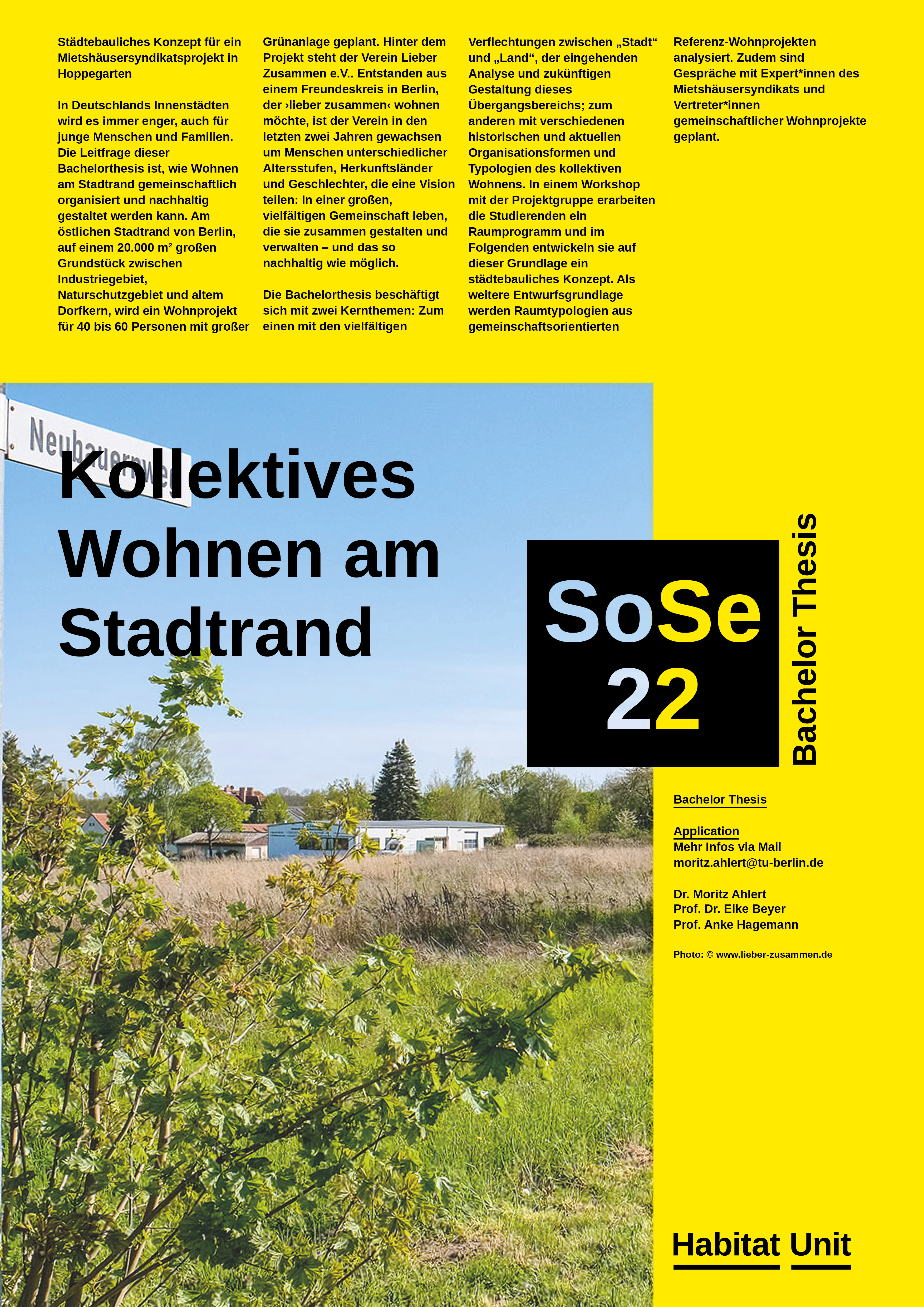
In Deutschlands Innenstädten wird es immer enger, auch für junge Menschen und Familien. Die Leitfrage dieser Bachelorthesis ist, wie Wohnen am Stadtrand gemeinschaftlich organisiert und nachhaltig gestaltet werden kann. Am östlichen Stadtrand von Berlin, auf einem 20.000 m² großen Grundstück zwischen Industriegebiet, Naturschutzgebiet und altem Dorfkern, wird ein Wohnprojekt für 40 bis 60 Personen mit großer Grünanlage geplant. Hinter dem Projekt steht der Verein Lieber Zusammen e.V.. Entstanden aus einem Freundeskreis in Berlin, der ›lieber zusammen‹ wohnen möchte, ist der Verein in den letzten zwei Jahren gewachsen um Menschen unterschiedlicher Altersstufen, Herkunftsländer und Geschlechter, die eine Vision teilen: In einer großen, vielfältigen Gemeinschaft leben, die sie zusammen gestalten und verwalten – und das so nachhaltig wie möglich.
Die Bachelorthesis beschäftigt sich mit zwei Kernthemen: Zum einen mit den vielfältigen Verflechtungen zwischen „Stadt“ und „Land“, der eingehenden Analyse und zukünftigen Gestaltung dieses Übergangsbereichs; zum anderen mit verschiedenen historischen und aktuellen Organisationsformen und Typologien des kollektiven Wohnens. In einem Workshop mit der Projektgruppe erarbeiten die Studierenden ein Raumprogramm und im Folgenden entwickeln sie auf dieser Grundlage ein städtebauliches Konzept. Als weitere Entwurfsgrundlage werden Raumtypologien aus gemeinschaftsorientierten Referenz-Wohnprojekten analysiert. Zudem sind Gespräche mit Expert*innen des Mietshäusersyndikats und Vertreter*innen gemeinschaftlicher Wohnprojekte geplant.
Photo: © www.lieber-zusammen.de
- Trainer/in: Moritz Ahlert
- Trainer/in: David Bauer
- Trainer/in: Anke Hagemann