
Kurser
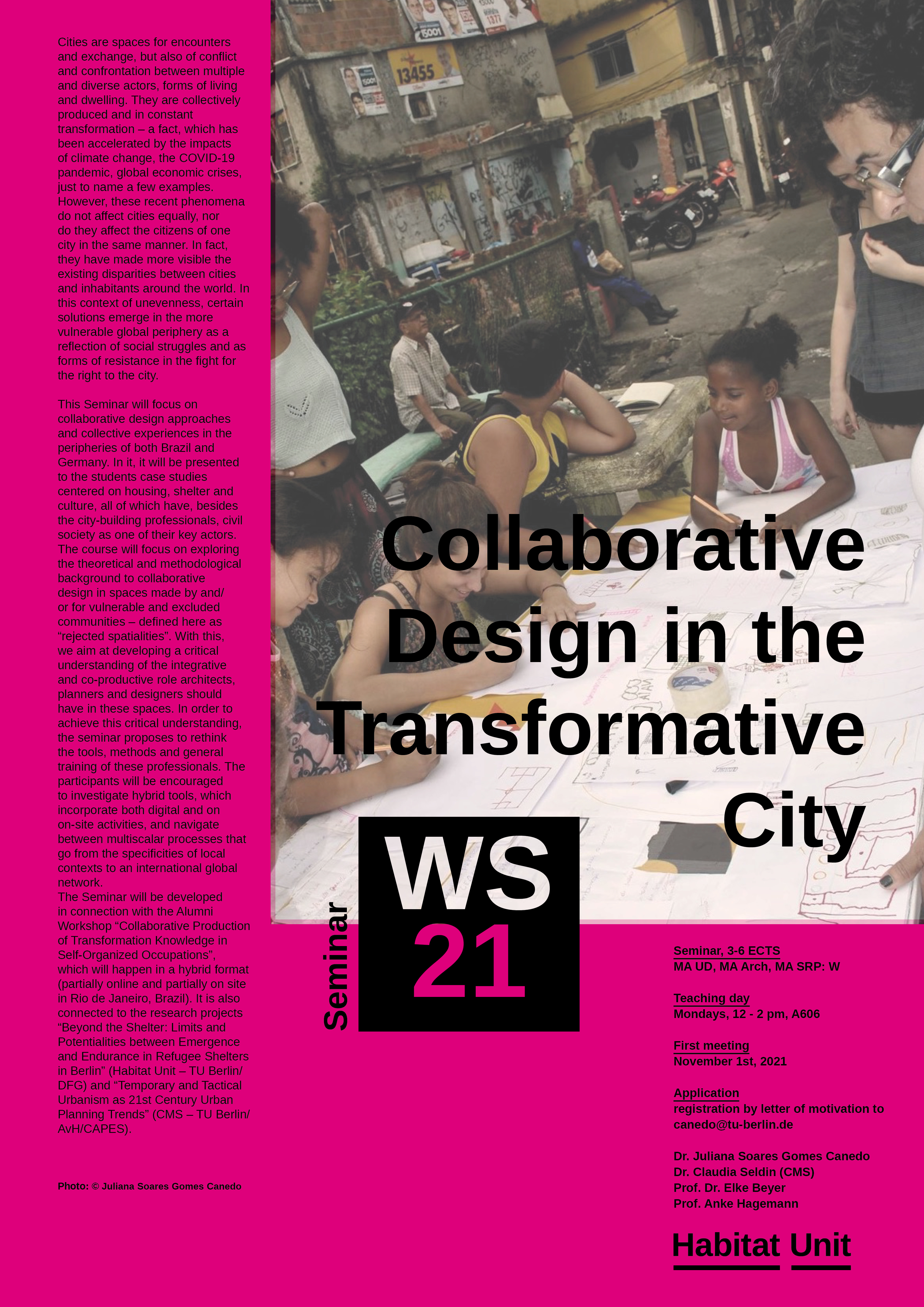
Collaborative Design in the Transformative City
The Seminar will be developed in connection with the Alumni Workshop “Collaborative Production of Transformation Knowledge in Self-Organized Occupations”, which will happen in a hybrid format (partially online and partially on site in Rio de Janeiro, Brazil). It is also connected to the research projects “Beyond the Shelter: Limits and Potentialities between Emergence and Endurance in Refugee Shelters in Berlin” (Habitat Unit – TU Berlin/DFG) and “Temporary and Tactical Urbanism as 21st Century Urban Planning Trends” (CMS – TU Berlin/AvH/CAPES).
- Trainer/in: Claudia Seldin
- Trainer/in: Juliana Soares Gomes Canedo
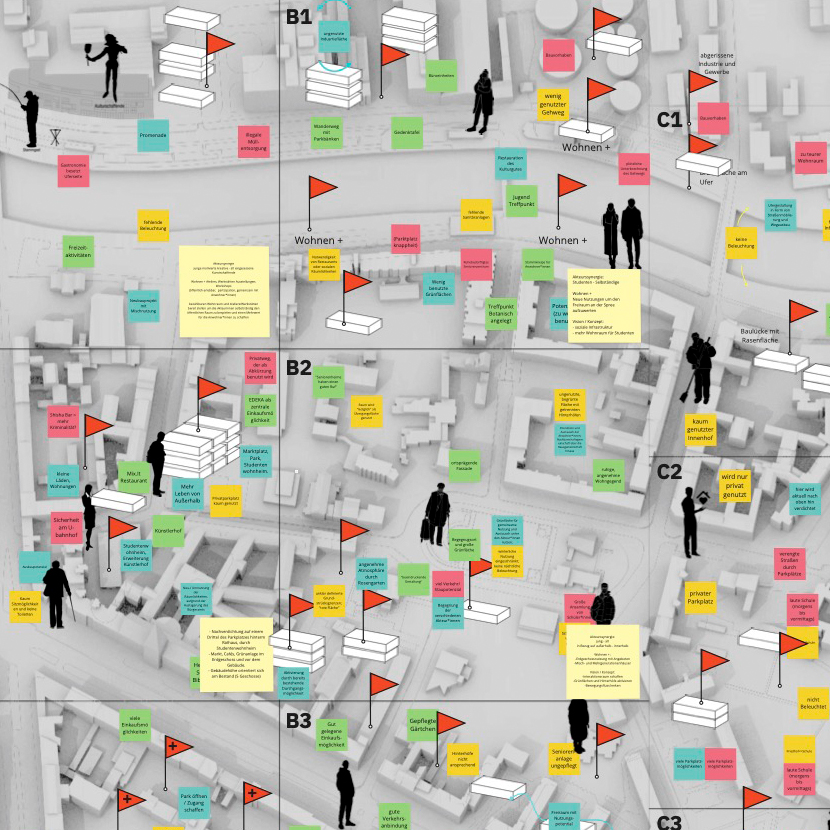
Berlin ist viele Städte, Berlin hat viele Zentren und noch mehr Kieze. Berlin ist eine Enzyklopädie. Die Großstadt wie wir sie heute kennen wurde vor hundert Jahren aus einer Unzahl von Kleinstädten und Landgemeinden zu den 20 Bezirken Groß-Berlins vereinigt. Noch heute sind diese Fragmente und Sub-Zentren klar erkennbar – wie das ehemalige Dorf Alt-Lietzow im Bezirk Charlottenburg. Charlottenburg steht selten im Fokus der aktuellen Berliner Stadtentwicklungsdebatte, seine Alltagsorte sind deshalb aber nicht weniger relevant und aufschlussreich, umkämpft und mit dichten Akteurskonstellationen ausgestattet.
Fokus dieses BA Studios ist es, den Wandel eines alltäglichen Kiezes im Bezirk Charlottenburg als Teil des Gefüges von Groß-Berlin zu analysieren und dessen Transformation weiterzudenken. Dabei werden sowohl lokale als auch großräumliche Trends mitgedacht. Insbesondere beschäftigt sich das Studio mit städtischer Produktion in Zusammenhang mit der demografischen Entwicklung: Wie können Wohnen und Arbeiten im Stadtviertel oder in einzelnen Gebäuden ineinander greifen? Wie können Lebensräume für eine zunehmend alleinwohnende und alternde Bevölkerung geschaffen und in das städtische Leben integriert werden? Wie muss das Verhältnis von öffentlichen und privaten Räumen (neu) gedacht werden?
In einer Sequenz von methodischen Übungen werden die materiellen und räumlichen sowie die sozialen, ökonomischen und kulturellen Zusammenhänge und Prozesse untersucht und weitergedacht, um sich Charlottenburgs Alltagsorten lexikographisch anzunähern. Zudem erlernen Teilnehmer*innen ein erweitertes, kritisches Selbstverständnis von Architekt*innen und Planer*innen in einem zunehmend „unscharfen“ Handlungsfeld und entwickeln ein Spektrum an Möglichkeiten strategischen Handelns für das Entwerfen von lebendigen, inklusiven und „koproduzierten“ Räumen der Transformation.
- Trainer/in: Moritz Ahlert
- Trainer/in: David Bauer
- Trainer/in: Anke Hagemann
- Trainer/in: Ludwig Thanhäuser
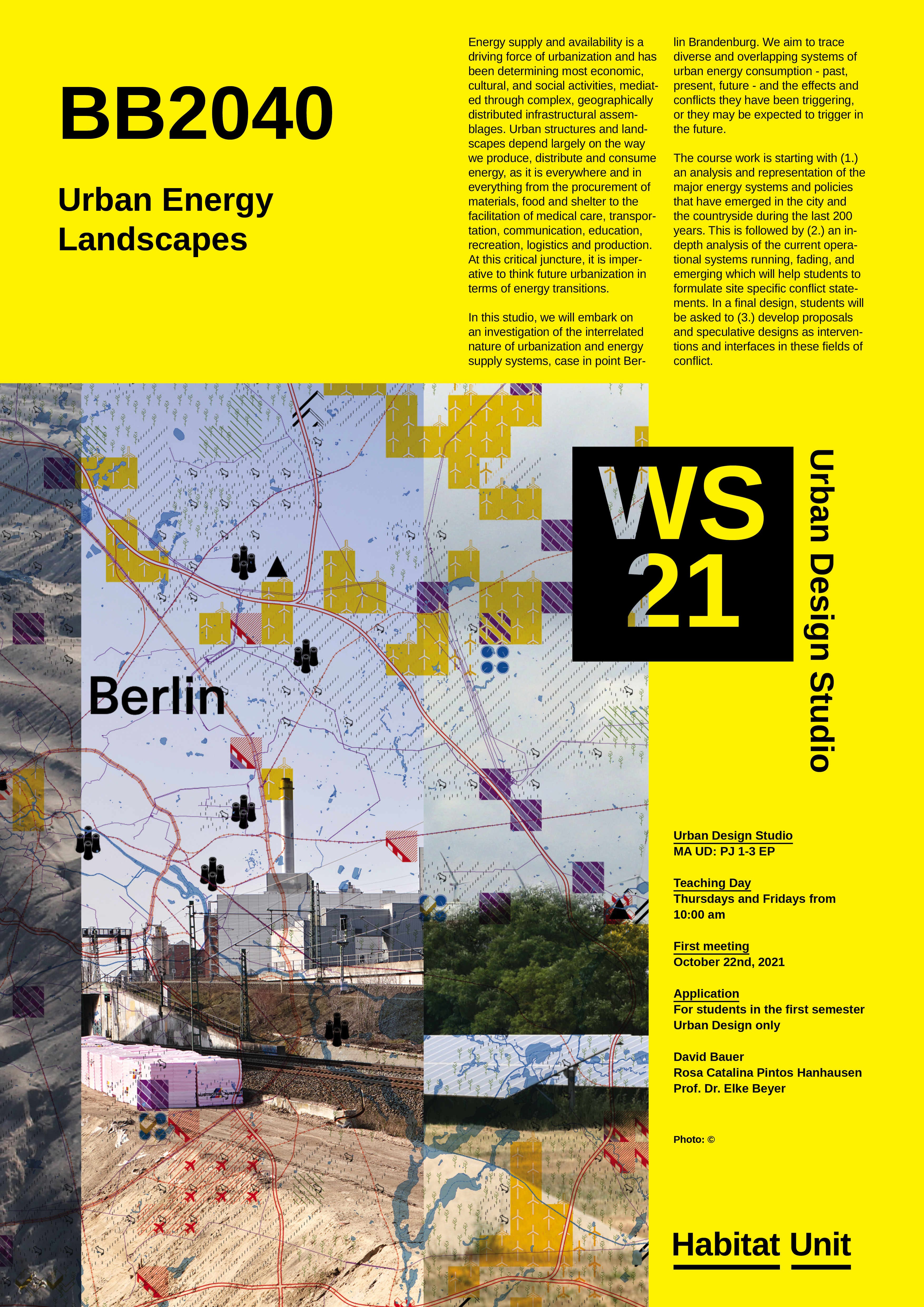
BB2040 - Urban Energy Landscapes (Urban Design Studio)
In this studio, we will embark on an investigation of the interrelated nature of urbanization and energy supply systems, case in point Berlin Brandenburg. We aim to trace diverse and overlapping systems of urban energy consumption - past, present, future - and the effects and conflicts they have been triggering, or they may be expected to trigger in the future.
The course work is starting with (1.) an analysis and representation of the major energy systems and policies that have emerged in the city and the countryside during the last 200 years. This is followed by (2.) an in-depth analysis of the current operational systems running, fading, and emerging which will help students to formulate site specific conflict statements. In a final design, students will be asked to (3.) develop proposals and speculative designs as interventions and interfaces in these fields of conflict.
- Trainer/in: David Bauer
- Trainer/in: Christian Georg Haid
- Trainer/in: Juliana Soares Gomes Canedo
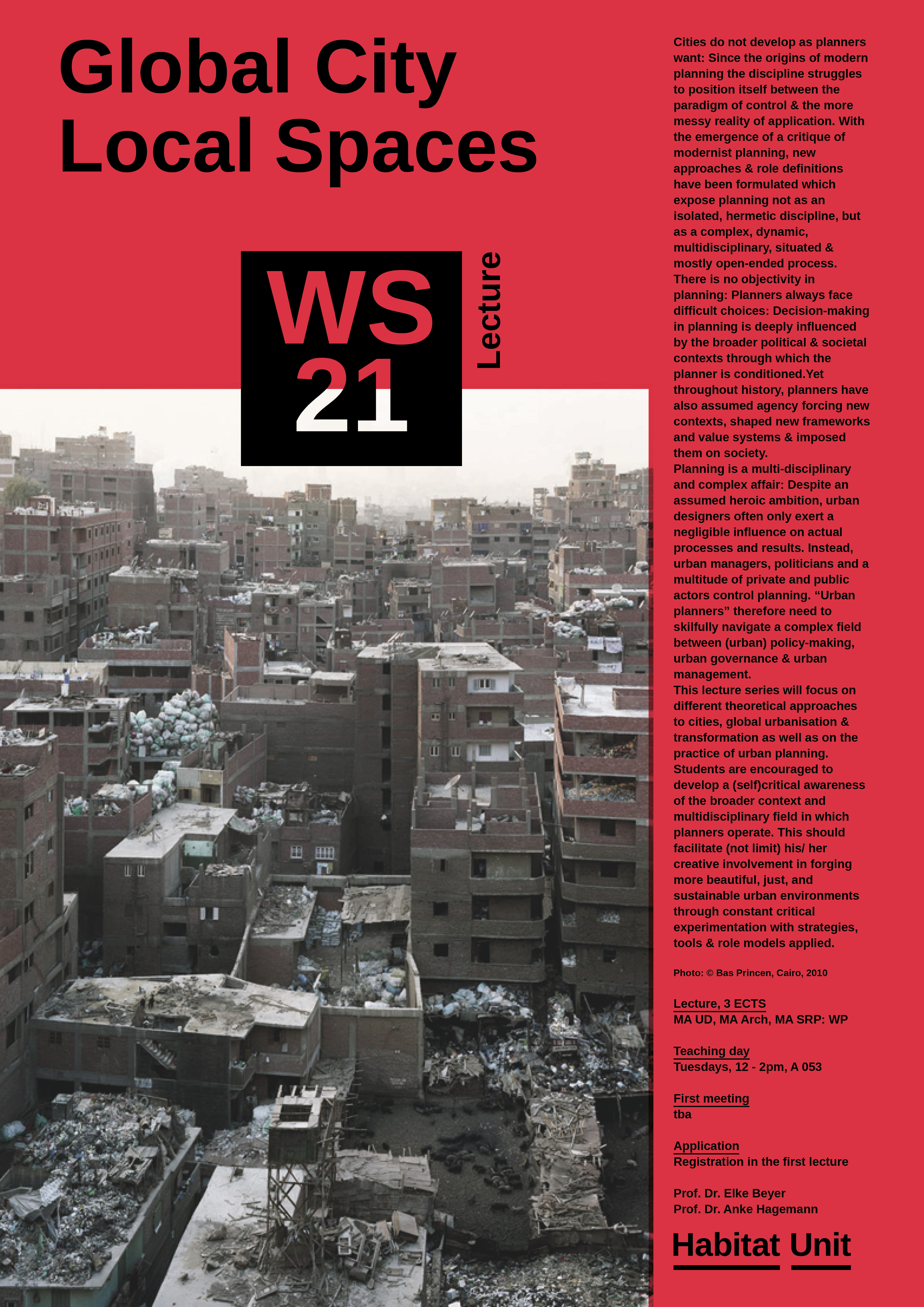
Global City Local Spaces
Cities do not develop as planners want: Since the origins of modern planning the discipline struggles to position itself between the paradigm of control and the more messy reality of application. With the critique of modernist planning, new approaches and role definitions have been formulated which expose planning not as an isolated, hermetic discipline, but as a complex, dynamic, multi-disciplinary, situated and mostly open-ended process involving a multitude of voices and actors. Decision-making in planning is deeply influenced by broader political and societal contexts, while urban managers, politicians and a multitude of private and public actors exert control over many urban processes and sites.
This lecture series will focus on different theoretical and analytical approaches to urban settlements, global urbanisation and transformation as well as on the practice of urban planning. It is structured in three blocks, addressing key questions such as: How can one define the urban as a field of inquiry and planning practice in a planetary perspective? How is the knowledge base of planning generated by different disciplines and across geographies of expertise and power? How can one build an understanding of the co-production of urban space as a toolbox for more inclusionary, sustainable and just planning and design strategies?
The principle of making the co-production and the open borders of urban planning knowledge explicit also informs the set-up of the lecture series: In order to represent the spectrum of approaches to urban design and research at Habitat Unit, the lecture brings together multiple voices by researchers and practitioners in the fields of planning, architecture, urban studies and sociology. Students are encouraged to develop a (self)critical awareness of the broader context and multidisciplinary field in which planners operate. This should facilitate (not limit) his/ her creative involvement in forging more beautiful, just, and sustainable urban environments.
- Trainer/in: Anke Hagemann
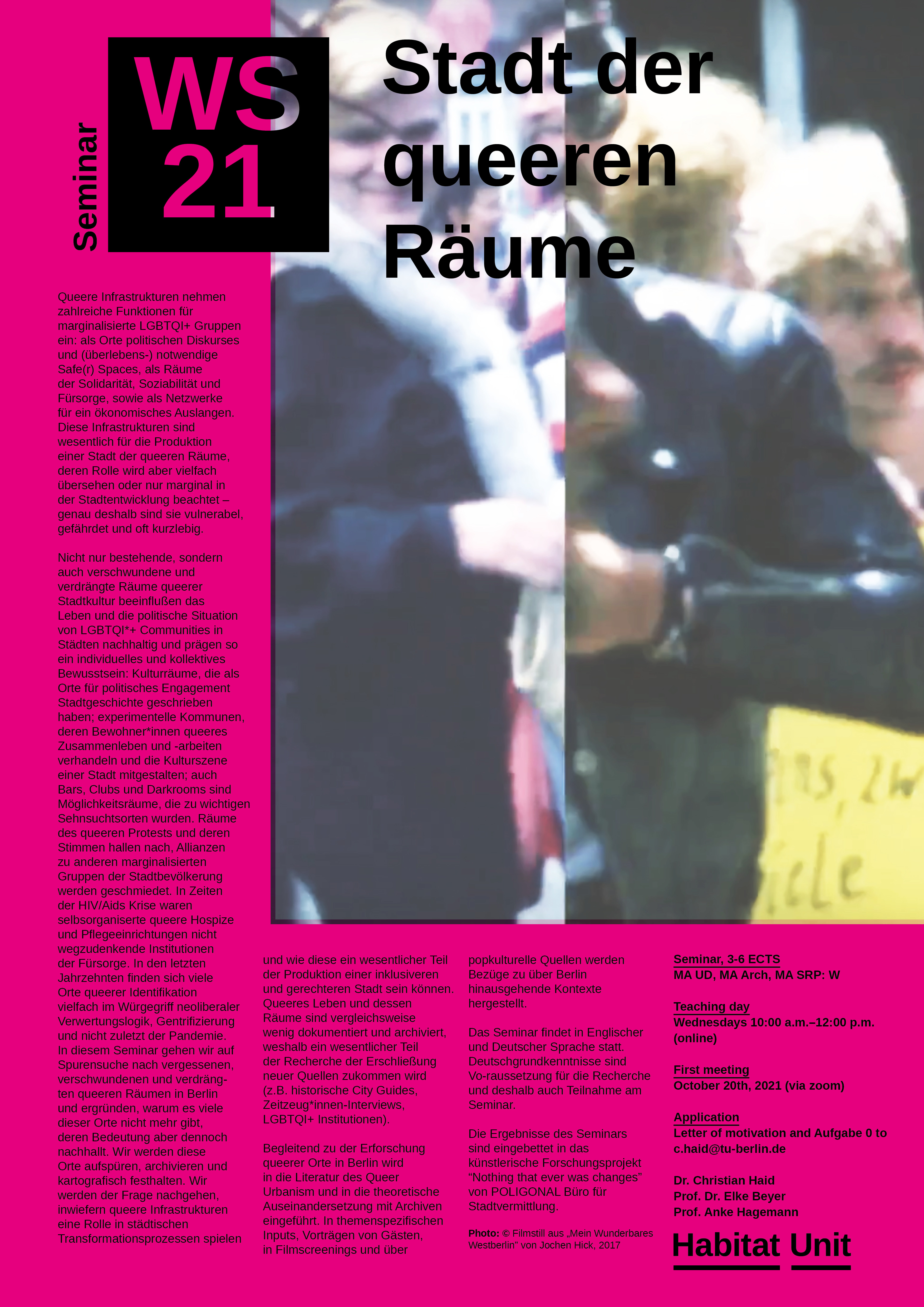
Stadt der queeren Räume
Queere Infrastrukturen nehmen zahlreiche Funktionen für
marginalisierte LGBTQI+ Gruppen ein: als Orte politischen Diskurses und
(überlebens-) notwendige Safe(r) Spaces, als Räume der Solidarität,
Soziabilität und Fürsorge, sowie als Netzwerke für ein ökonomisches
Auslangen. Diese Infrastrukturen sind wesentlich für die Produktion
einer Stadt der queeren Räume, deren Rolle wird aber vielfach übersehen
oder nur marginal in der Stadtentwicklung beachtet – genau deshalb sind
sie vulnerabel, gefährdet und oft kurzlebig.
Nicht nur bestehende, sondern auch verschwundene und verdrängte Räume
queerer Stadtkultur beeinflußen das Leben und die politische Situation
von LGBTQI*+ Communities in Städten nachhaltig und prägen so ein
individuelles und kollektives Bewusstsein: Kulturräume, die als Orte für
politisches Engagement Stadtgeschichte geschrieben haben;
experimentelle Kommunen, deren Bewohner*innen queeres Zusammenleben und
-arbeiten verhandeln und die Kulturszene einer Stadt mitgestalten; auch
Bars, Clubs und Darkrooms sind Möglichkeitsräume, die zu wichtigen
Sehnsuchtsorten wurden. Räume des queeren Protests und deren Stimmen
hallen nach, Allianzen zu anderen marginalisierten Gruppen der
Stadtbevölkerung werden geschmiedet. In Zeiten der HIV/Aids Krise waren
selbsorganiserte queere Hospize und Pflegeeinrichtungen nicht
wegzudenkende Institutionen der Fürsorge. In den letzten Jahrzehnten
finden sich viele Orte queerer Identifikation vielfach im Würgegriff
neoliberaler Verwertungslogik, Gentrifizierung und nicht zuletzt der
Pandemie.
In diesem Seminar gehen wir auf Spurensuche nach
vergessenen, verschwundenen und verdrängten queeren Räumen in Berlin und
ergründen, warum es viele dieser Orte nicht mehr gibt, deren Bedeutung
aber dennoch nachhallt. Wir werden diese Orte aufspüren, archivieren und
kartographisch festhalten. Wir werden der Frage nachgehen, inwiefern
queere Infrastrukturen eine Rolle in städtischen
Transformationsprozessen spielen und wie diese ein wesentlicher Teil der
Produktion einer inklusiveren und gerechteren Stadt sein können.
Queeres Leben und dessen Räume sind vergleichsweise wenig dokumentiert
und archiviert, weshalb ein wesentlicher Teil der Recherche der
Erschließung neuer Quellen zukommen wird (z.B. historische City Guides,
Zeitzeug*innen-Interviews, LGBTQI+ Institutionen).
Begleitend zu
der Erforschung queerer Orte in Berlin wird in die Literatur des Queer
Urbanism und in die theoretische Auseinandersetzung mit Archiven
eingeführt. In themenspezifischen Inputs, Vorträgen von Gästen, in
Filmscreenings und über popkulturelle Quellen werden Bezüge zu über
Berlin hinausgehende Kontexte hergestellt.
Das Seminar findet in
Englischer und Deutscher Sprache statt. Deutschgrundkenntnisse sind
Voraussetzung für die Recherche und deshalb auch Teilnahme am Seminar.
Die
Ergebnisse des Seminars sind eingebettet in das künstlerische
Forschungsprojekt “Nothing that ever was changes” von POLIGONAL Büro für
Stadtvermittlung.
City of queer spaces
Queer infrastructures have multiple functions for marginalized LGBTQI+ groups: as sites of political discourse and safe(r) spaces sometimes necessary for survival, as spaces of solidarity, sociability, and care, and as networks for economic livelihoods. These infrastructures are essential to the production of a city of queer spaces, but their role is often overlooked or only marginally considered in urban development - which is precisely why they are vulnerable, endangered, and often short-lived.
Also already disappeared and displaced spaces of queer urban culture have a lasting impact on the lives and political situation of LGBTQI*+ communities in cities and thus impact on their collective memory: cultural spaces that have made urban history as places for political engagement; experimental communes whose residents negotiate queer living and working together and help shape a city's cultural scene; bars, clubs, and darkrooms can become spaces of possibility but also places of longing. Spaces of queer protest and their voices reverberate, alliances are forged with other marginalized groups in the urban population. In times of the HIV/AIDS crisis, self-organized queer hospices and care facilities were indispensable institutions of care. In recent decades, neoliberal exploitation logics, gentrification, and last but not least, the pandemic have put a stranglehold on many places of queer identification.
In this seminar, we will detect and analyze forgotten, disappeared, and displaced queer spaces in Berlin and explore why many of these places no longer exist, yet significantly resonate in the queer community’s memory. We will track down, archive, and map these places. We will explore the ways in which queer infrastructures play a role in urban transformation processes and how they can be an essential part of producing a more inclusive and equitable city. Queer life and its spaces are comparatively poorly documented and archived, which is why a significant part of the research will be devoted to opening up new sources (e.g. historical city guides, oral histories, sources from LGBTQI+ institutions).
The research of queer places in Berlin will be accompanied by an introduction to the literature of queer urbanism and the theoretical discussion of archives. In topic-specific inputs, lectures by guests, in film screenings and via pop cultural sources, references to contexts beyond Berlin will be made.
The seminar will be held in English and German. A basic knowledge of German is a prerequisite for the research and therefore also for participation in the seminar.
The results of the seminar are embedded in the artistic research project "Nothing that ever was changes" by POLIGONAL Office for Urban Communication.
- Trainer/in: Christian Georg Haid