
Sous-catégories
Cours

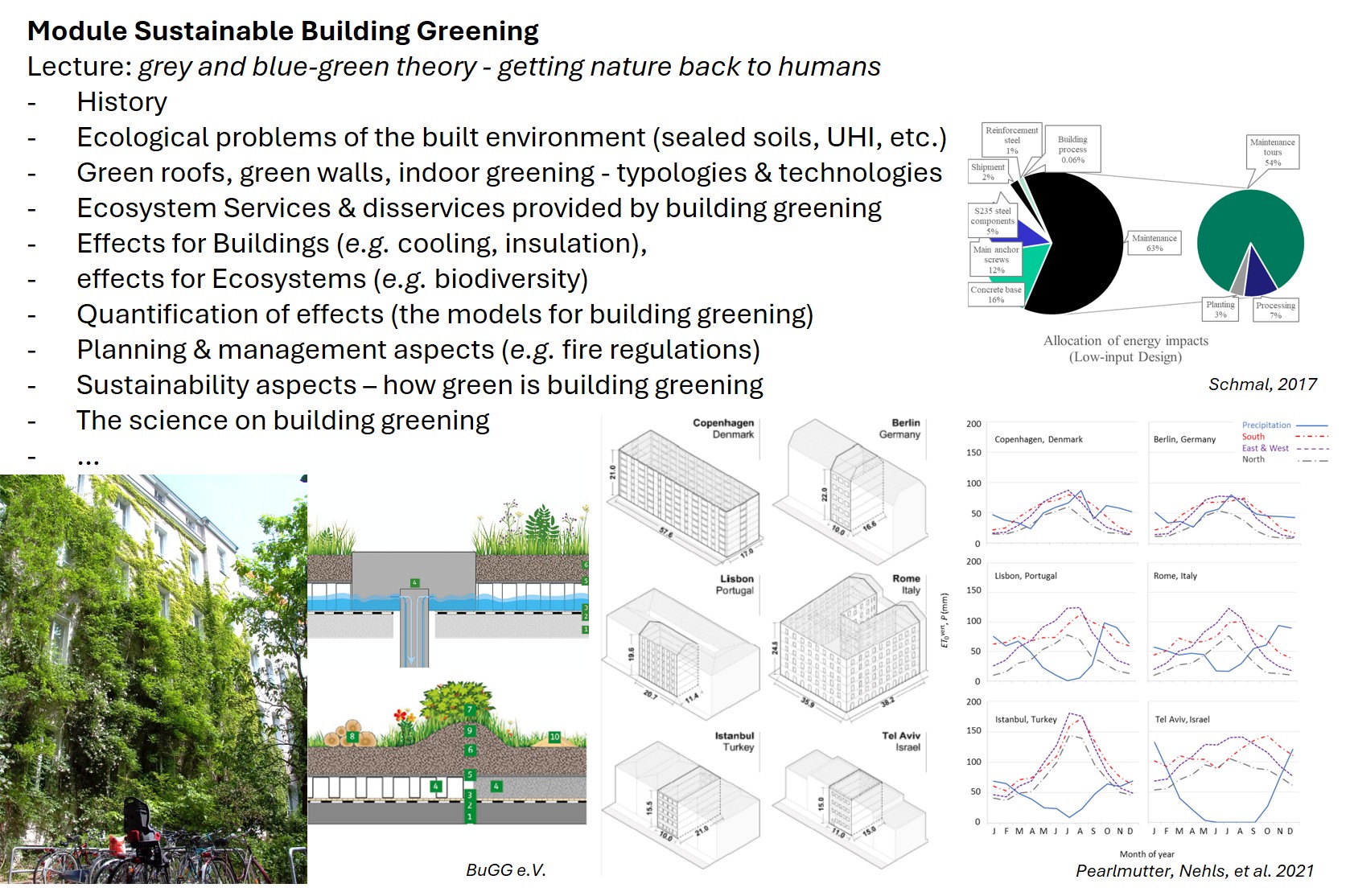
Lecture: grey and blue-green theory - getting nature back to humans
From the first visit to implementation
Design, permits, statics, fire regulations, irrigation, plants
Use of a low impact system (www.fabikli.de)
Hands on:
Testing details
Installation of the system
Maintenance tours
Information concept
Public tours
…
- Trainer/in: Thomas Nehls
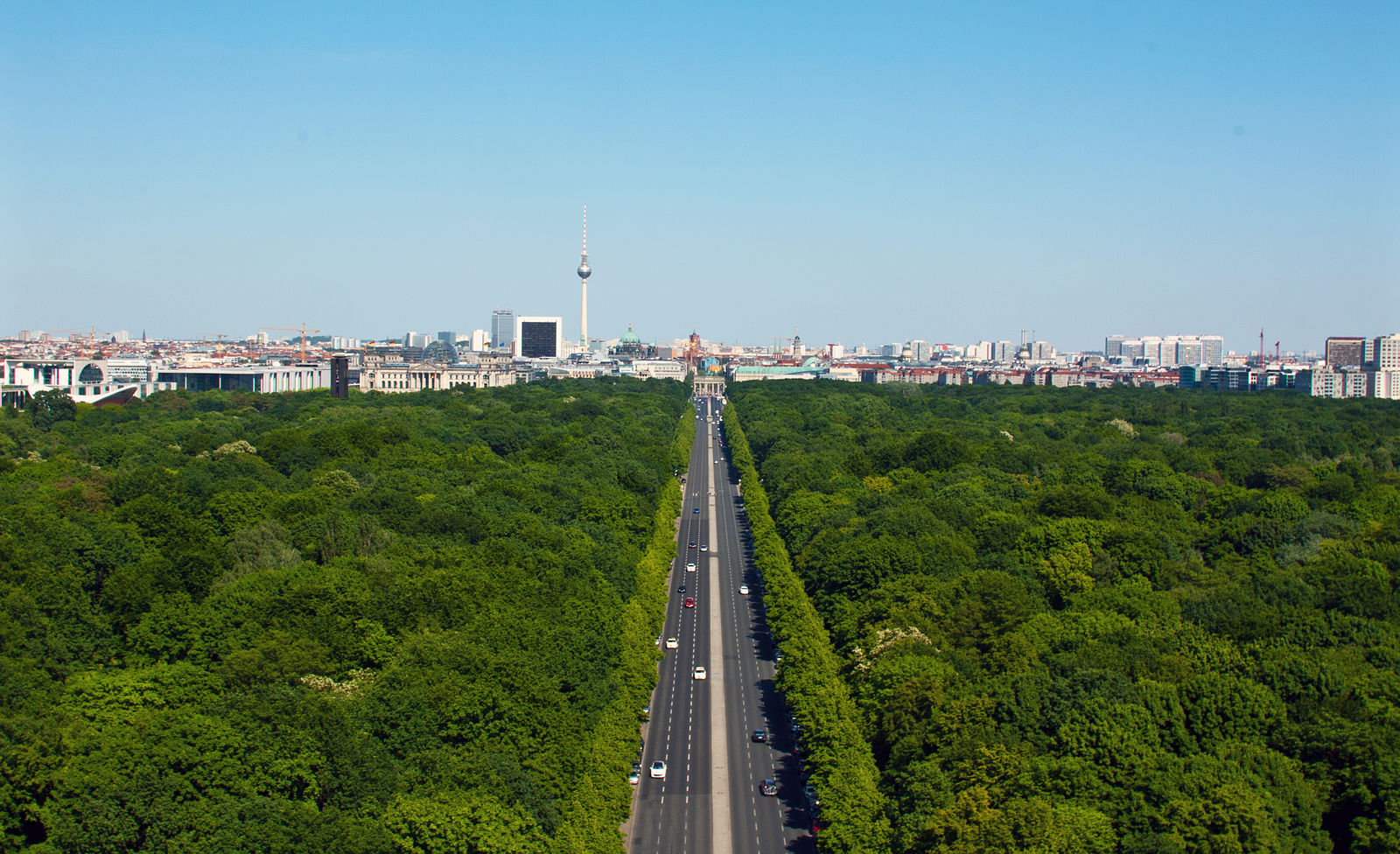
Decisions around land use and land management have wide-reaching impact on a variety of ecological metrics including soil chemistry, microclimate, and biodiversity. Contrasting the ecology of various land types ranging from urban, suburban, agricultural, or more natural habitat such as forested area, can provide us information regarding these land uses’ role in climate change, nutrient pollution, and overall ecological health. Furthermore, urban ecology always includes a human dimension, invoking sociopolitical and historical dimensions related to land use, with environmental outcomes of such decisions not evenly distributed among all populations.
Urban green spaces are widely encouraged for their potential to provide a variety of ecosystem services including climate mitigation (either locally through reduction in urban heat island effect or globally through their potential to sequester carbon), promotion of biodiversity, stormwater management, and more. As part of this course, we will collect ecologic samples from a centrally located urban park, an urban forest, and a forest on the outskirts of the city in Brandenburg. Data collected will include soil cores, plant data, and other ecologic metrics. These contexts will be contrasted to help to assess differences in ecologic conditions, considering what this may mean for urban land management.
- Trainer/in: Melina Bianca Höfling
- Trainer/in: Varvara Kosova
- Trainer/in: Christopher Ryan
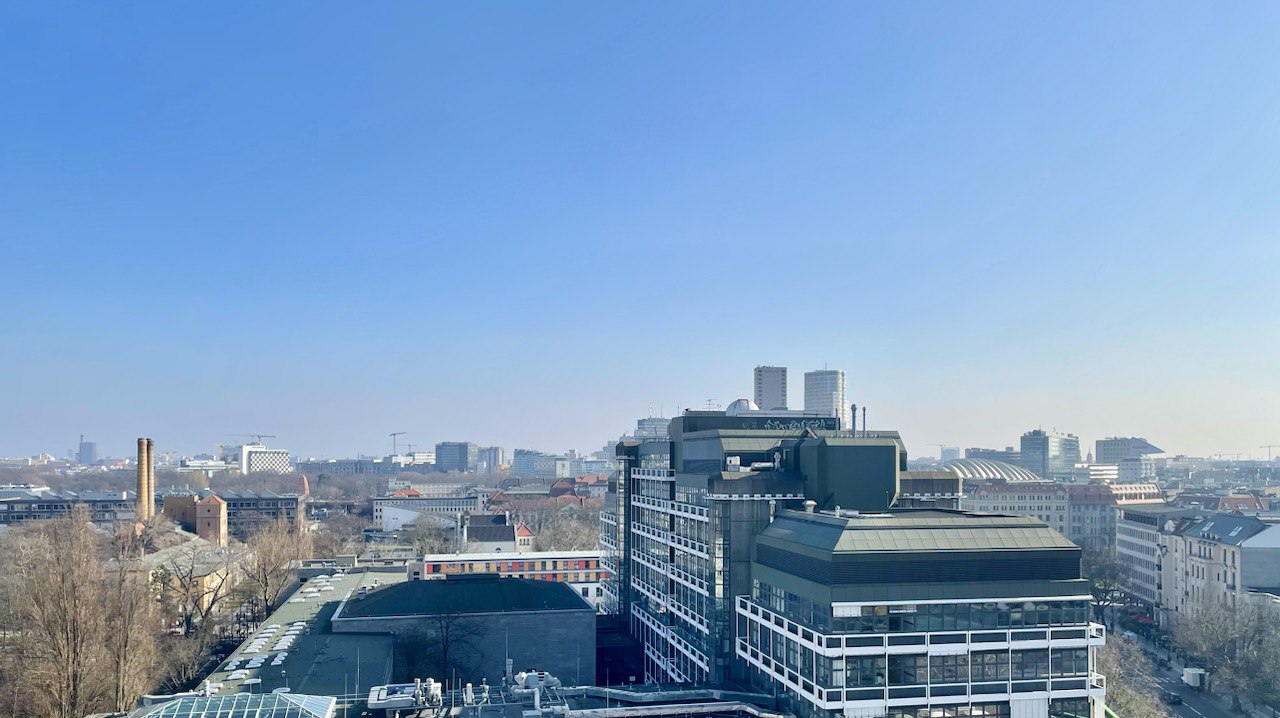
Cities, Materials, and the Climate
Department for Urban Ecosystem Sciences
- Trainer/in: Galina Churkina
- Trainer/in: Melina Bianca Höfling
- Trainer/in: Varvara Kosova

This course is offered by the Department for Urban Ecosystem Science by Prof. Galina Churkina, Dr. Christopher Ryan and PhD candidate Alexander Plakias.
It takes place on Wednesdays, 10 am – 2 pm, starting April 15th.
- Trainer/in: Galina Churkina
- Trainer/in: Melina Bianca Höfling
- Trainer/in: Varvara Kosova
- Trainer/in: Alexander Plakias
- Trainer/in: Christopher Ryan
Welcome to the colloquium of the Department of Urban Ecosystem Sciences at the Institute of Ecology at TU Berlin!
The colloquium offers space to present and discuss the freshest research, planned projects and student theses as well as proven concepts and frameworks.
The events take place regularly, approximately every two weeks, and are open to anyone interested in the topics. Details on topics, rooms (usually BH-N 812) and dates are communicated via this platform.
Students writing their thesis in our department are expected to pitch their work at the beginning of their journey, as well as give a final talk. Thank you for your contributions to the colloquium!
If you do not have a university account, please send us an e-mail and we will provide you with guest access.
- Trainer/in: Xinxin Bao
- Trainer/in: Galina Churkina
- Trainer/in: Melina Bianca Höfling
- Trainer/in: Varvara Kosova
- Trainer/in: Thomas Nehls
- Trainer/in: Simon Phillips
- Trainer/in: Alexander Plakias
- Trainer/in: Christopher Ryan
- Trainer/in: Sebastian Schubert