
Cursos
ARTIFICAL NATURES I
Digital computational architecture has been emerging over the last decades. By using digital tools architects and designers are enabled to generate thousands of design options with more or less complex geometries, create city patterns or new typologies with the help of deep neural networks; possibly to be evaluated against set criteria in order to choose ‘the best one’. Being critical towards ‘random’ use of digital tools because we can, this Artificial Natures offers an overview over computational architecture, of which the very tools are just one part of many. The goal of Artificial Natures is to inform students about a variety of ingredients for understanding and possibly designing with the assistance of computation.
The course is structured in five modules:
- computational thinking
- digital computational tools
- analysis of urban data
- machine learning
- computational biology
Artificial Natures is a dual online class we developed and will teach together with ESU Lab, Mansoura University Egypt. The course is attached to the lecture series hello biology.
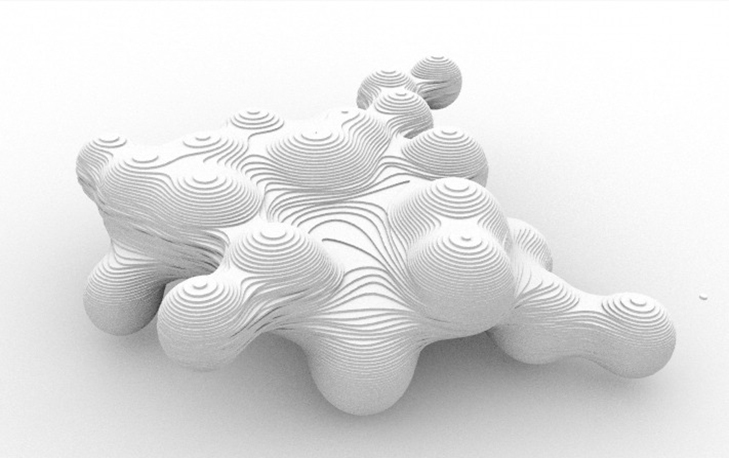
Urban and architectural design strategies are experiencing a paradigm shift. Questions on how to transform our current cities and how to design our future cities are driven by economics, globalization, politics, demographics and ecology. We are in search of new architectural typologies and urban organization to integrate biodiversity and artificial natures. Now, we have digital tools at hand, can quantify infinite phenomena and trade data like oil. The ecological question, and the question of the human condition in the midst of bitcoin farms and styrofoam insulation systems, however, has not been answered as yet. During the studio, we will ask the question of how can we understand our environment and our world that is overwhelmed with analog and digital complexity, equipped with fluid terrains in a new AI cyberspace in order to create ecological urban habitat. Our sites are linear empty stretches along the S-Bahn, crawling and extending into contradicting parts of the city. Your design proposals will be driven by bio-diversity, imagination and radical rethinking of methodologies that utilize cybernetic thinking and computational making. The studio, therefore, will be supported by the PIV, orchestrated by the Chair of Architectural Theory.
Morphing Ecologies is computational driven, skills such as Grasshopper and Python are welcome.
https://cyphylab.chora.tu-berlin.de | contact: <span lang="EN-US">cyphylab@architektur.tu-berlin.de</span>