
Corsi
Master Thesis Projects
At Habitat Unit, we supervise a number of free master thesis projects each term and offer a master colloquium for presentations and exchange. To find out more about the methodologies, themes and research expertise you can expect to find at Habitat Unit, it is recommended to do a seminar or design project with us before. Proposals to develop master thesis projects are also very welcome in many research projects based at the chair – please explore our website for current themes and researchers' contact information. However, we cannot promise that we'll be able to supervise everybody who applies.
Basics
A free master thesis should be based on your own idea and offers the chance to develop your own theme into an original, independent project in dialogue with us.
At Habitat Unit, we especially welcome thesis projects with a strong relation to contextual and collaborative urban design, as well as research-based themes or theoretical explorations related to the key areas of teaching and research in international urbanism at the chair. We will select proposals based on how well they are thought out and on how well they match our approaches and expertise. Free master thesis projects require a substantial degree of independence and self-organisation. Our role is to consult and help you in the development of your own project.
We offer supervision in English and/or German, depending on the background of the supervisors and candidates. Colloquia are held mainly in English but some projects may be presented, discussed or written in German. The regular master colloquium is an essential forum – we expect you to engage in lively discussion and exchange. It can also help in building a support network beyond the supervision offered by teaching staff and researchers. In summer term 2022 (Vorlesungszeit), the master colloquium will take place every third Tuesday of the month starting at 9am. Dates during the holidays tbc. For MSc Architecture students, it is recommended to follow the time-plan for free themes from IfA (usually published at the end of each semester)
- Trainer/in: Anke Hagemann
- Trainer/in: Philipp Misselwitz
- Trainer/in: Aikaterini Tzouvala
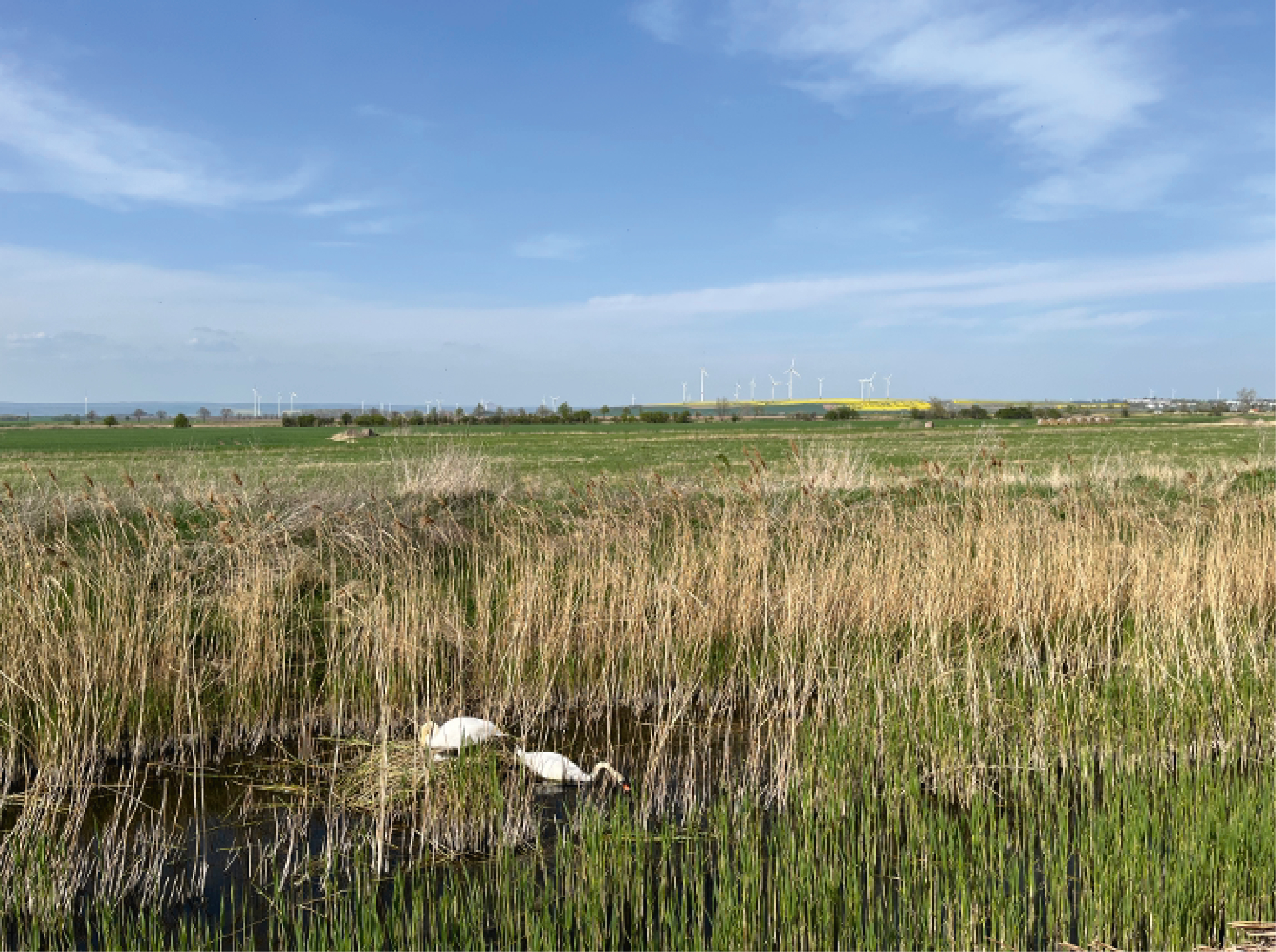
While fetishizing cities in an urban age, the spatial development of sparsely populated and rural areas has been disregarded by urban research and planning in recent decades. At the same time, landscapes of an extended urbanization have been the subject of considerable physical transformation. Productive soils – in a material and spatial sense – represent the major resource for the supply of concentrated urban areas (for the production of food, biofuels, solar and wind energy, building materials, and recreational spaces ). Therefore they have also become critical in the sustainable transition of our living environments: building transition, food transition, and energy transition all require extensive areas of land and fertile grounds. Simultaneously, the contemporary rural landscape is further stressed by industrial agriculture and forestry, mineral resource extraction, soil degradation, ecological crisis and the effects of climate change.
The Productive Soils Urban Design studio addresses these multiple challenges and the exhaustion of rural soils and explores alternative transformations of the socio-spatial landscape of Berlin’s hinterland. It focuses on productive soils and land-use patterns in unbuilt areas around Angermünde/Brandenburg as the starting point for (currently mainly uni-directional) rural-to-urban material flows. Based on the analysis of such patterns and flows, and their respective infrastructures, it aims to re-think food, energy, and construction material supply with a systemic, more regional, circular and spatially just approach – and envisions the respective change of actor networks and physical landscapes. In doing so, the studio will probe, how an urban design perspective and methodo-logy can contribute to not only better understand such systems but also instigate an encompassing sustainable transition of agriculture, forestry, human recreation, more-than-human habitats and “nature” in the future production of rural soil landscapes.
We will cooperate with the think tank Bauhaus Earth, the City of Angermünde and a number of stakeholders and initiatives in the area.
- Trainer/in: Anke Hagemann
- Trainer/in: Christian Georg Haid
- Trainer/in: Tuanne Monteiro de Carvalho
- Trainer/in: Juliana Soares Gomes Canedo
- Trainer/in: Aikaterini Tzouvala
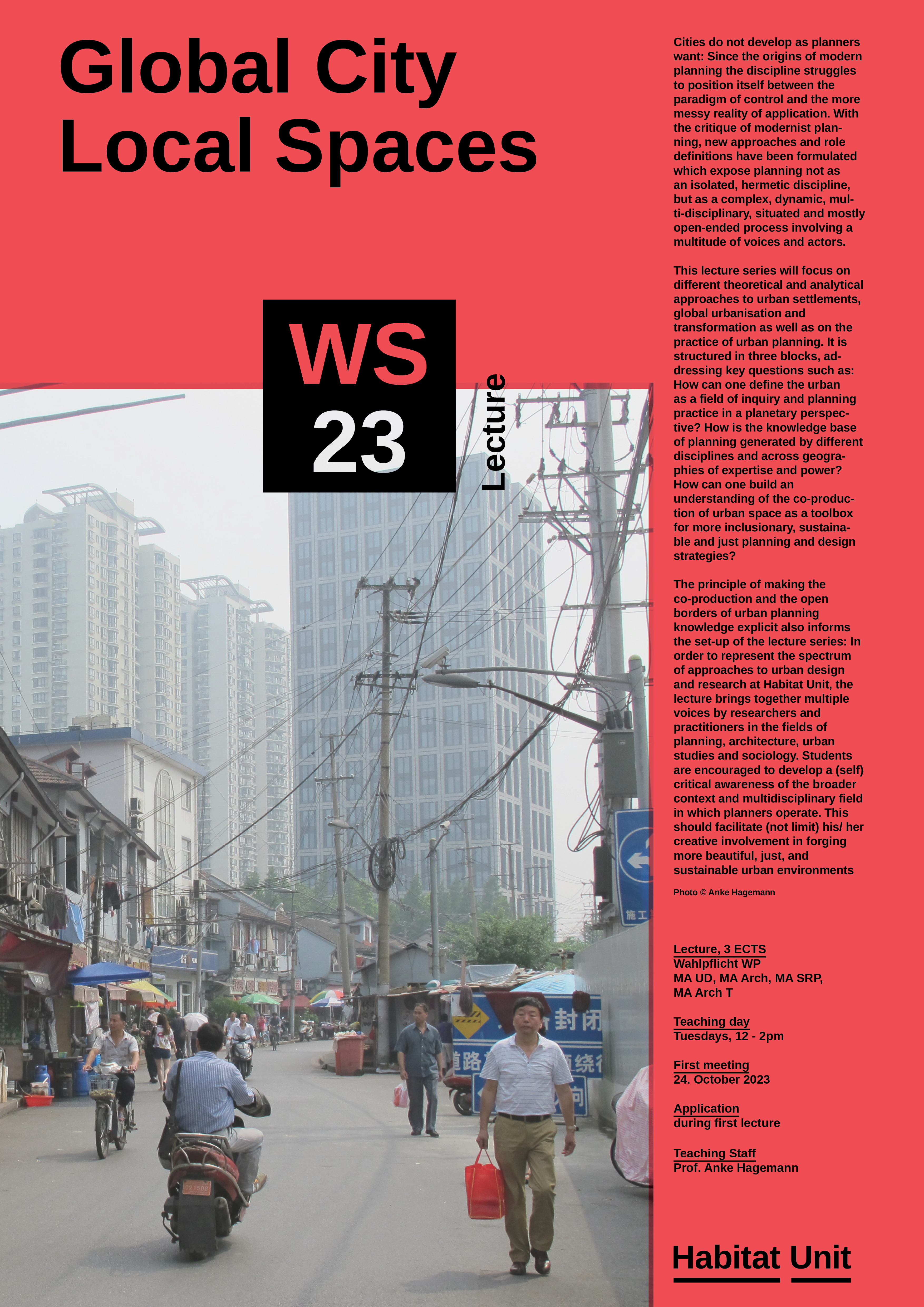
Global City Local Spaces
This lecture series will focus on different theoretical and analytical approaches to urban settlements, global urbanisation and transformation as well as on the practice of urban planning. It is structured in three blocks, addressing key questions such as: How can one define the urban as a field of inquiry and planning practice in a planetary perspective? How is the knowledge base of planning generated by different disciplines and across geographies of expertise and power? How can one build an understanding of the co-production of urban space as a toolbox for more inclusionary, sustainable and just planning and design strategies?
The principle of making the co-production and the open borders of urban planning knowledge explicit also informs the set-up of the lecture series: In order to represent the spectrum of approaches to urban design and research at Habitat Unit, the lecture brings together multiple voices by researchers and practitioners in the fields of planning, architecture, urban studies and sociology. Students are encouraged to develop a (self)critical awareness of the broader context and multidisciplinary field in which planners operate. This should facilitate (not limit) his/ her creative involvement in forging more beautiful, just, and sustainable urban environments.Photo © Anke Hagemann
- Trainer/in: Anke Hagemann
- Trainer/in: Aikaterini Tzouvala
Master Thesis Projects
At Habitat Unit, we supervise a number of free master thesis projects each term and offer a master colloquium for presentations and exchange. To find out more about the methodologies, themes and research expertise you can expect to find at Habitat Unit, it is recommended to do a seminar or design project with us before. Proposals to develop master thesis projects are also very welcome in many research projects based at the chair – please explore our website for current themes and researchers' contact information. However, we cannot promise that we'll be able to supervise everybody who applies.
Basics
A free master thesis should be based on your own idea and offers the chance to develop your own theme into an original, independent project in dialogue with us.
At Habitat Unit, we especially welcome thesis projects with a strong relation to contextual and collaborative urban design, as well as research-based themes or theoretical explorations related to the key areas of teaching and research in international urbanism at the chair. We will select proposals based on how well they are thought out and on how well they match our approaches and expertise. Free master thesis projects require a substantial degree of independence and self-organisation. Our role is to consult and help you in the development of your own project.
We offer supervision in English and/or German, depending on the background of the supervisors and candidates. Colloquia are held mainly in English but some projects may be presented, discussed or written in German. The regular master colloquium is an essential forum – we expect you to engage in lively discussion and exchange. It can also help in building a support network beyond the supervision offered by teaching staff and researchers. In summer term 2022 (Vorlesungszeit), the master colloquium will take place every third Tuesday of the month starting at 9am. Dates during the holidays tbc. For MSc Architecture students, it is recommended to follow the time-plan for free themes from IfA (usually published at the end of each semester)